 Build Your Future!
When you build a wheat flour milling line, the first figure to fix is not the equipment list but the daily capacity. Once capacity is fixed, floor area, transformer rating, building height and crew size follow; fix it the wrong way round and every quotation downstream has to be redone.
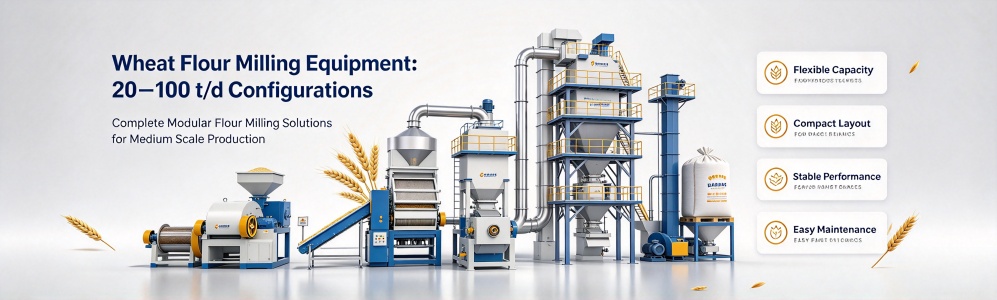
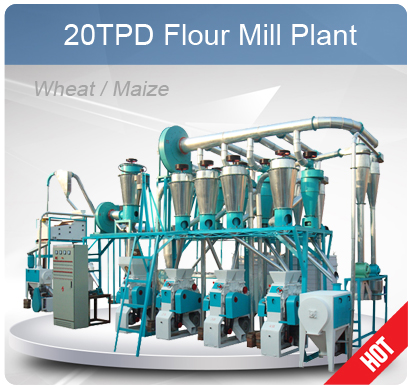
Wheat Flour Milling Equipment Price Across Four Capacity Bands: 20 to 100 t/d
Start with the published parameters from three commissioned wheat flour milling equipment projects. Across the column, capacity triples while extraction does not rise at all — it falls slightly. The reason is the grade basis, not a loss of efficiency.
|
Capacity |
Extraction (measured) |
Installed power |
Workshop |
Project |
|---|---|---|---|---|
|
20 t/d |
70–75% |
about 59 kW |
— |
product page |
|
30 t/d |
around 75% |
65 kW |
30×10×8 m |
|
|
60 t/d |
75–80% |
130 kW |
25×10×7 m |
|
|
100 t/d |
70–75% |
375 kW |
40×12×16 m |
The table carries no equipment cost. A quotation at any one band moves with roll count, sifting area, whether purification is independent, and air or manual control, so a single fixed figure would mislead.
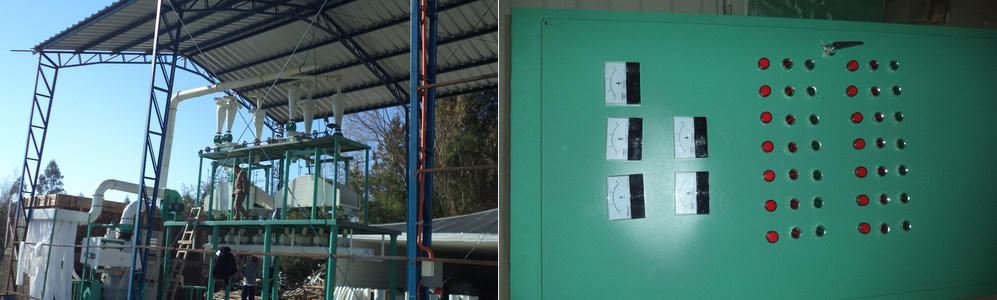
Left: Steel Structure and Floor Layout; Right: the Central Control Panel
The three bands with published parameters come from ABC Machinery projects already delivered and commissioned, so capacity, power and workshop dimensions can be checked item by item rather than taken from a brochure. Workshop dimensions do not compare linearly either: the 30 t/d band is a predominantly single-level layout at 300 m², the 60 t/d band is a multi-level compact layout at 250 m² — smaller in footprint — and the 100 t/d band runs to 16 m of height. Budget civil works from floors and height, never from another project's floor area.Put a milling process engineer on the line, not a sales script. Click the button below and describe the line you run.

In wheat flour milling equipment the recoverable points sit in five places: cleaning, tempering, roll passages, purification and bran finishing.
The equipment list for these five stages is built by ABC Machinery stage by stage against raw wheat and target grade, not by scaling a template to a tonnage — the same 60 t/d carries a different number of machines for straight-grade and multi-grade output. The order cannot be reversed, because each stage can only work with the stock the previous one hands it — precision lost upstream cannot be recovered downstream.
|
# |
Stage |
What it decides |
Published parameters |
Signal that it has failed |
|---|---|---|---|---|
|
1 |
Cleaning |
The starting ash. Stones of similar size to the grain are the usual leak |
Vibrating screen, destoner and scourer combination |
Ash rises across every flour stream at once |
|
2 |
Tempering |
Bran toughness. Dry bran shatters and the fragments pass the sifter |
Soft wheat 12–18 h, durum 18–24 h; moisture into the mill 14%–16%; control within 0.3% |
Ash climbs after a wheat change with settings untouched |
|
3 |
Roll passages |
How much endosperm each passage releases and how much bran it crushes |
Break-to-reduction ratio sets semolina yield |
Extraction drifts down over months with no single event |
|
4 |
Purification |
Separates clean endosperm from stock still carrying bran |
Purification cuts ash by 60%–70% |
One stream jumps in ash; the purifier moves stock without separating it |
|
5 |
Bran finishing |
Recovers finished flour adhering to bran |
The recovered weight counts straight into extraction |
Flour appears in the bran analysis |
The wheat flour milling process diagram below covers a complete set of wheat flour milling equipment, and is an engineering drawing produced by ABC Machinery for an actual line, not an illustration: from raw wheat intake to packed flour, the five equipment groups, pneumatic conveying and dust collection are all on it. Read the picture first, then the table.
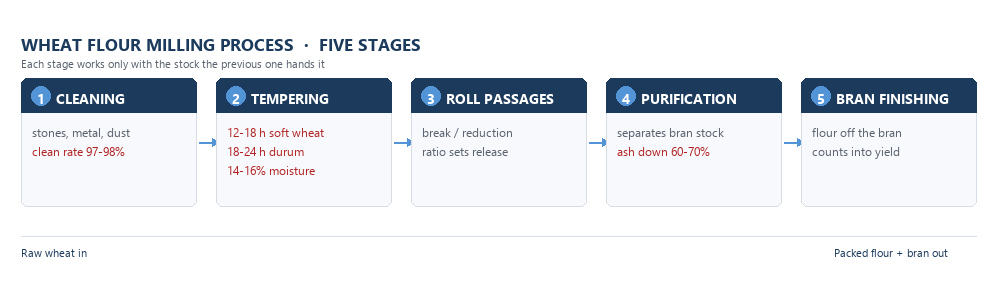
The Five Stages of The Wheat Flour Milling Process
Following the wheat flour milling process in order, stage by stage: what each one decides, and what signal appears when it fails.
Wheat Cleaning Equipment: Screen, Destoner and Scourer
Cleaning sets the starting ash. Mineral matter that survives the cleaning section enters the mill and is distributed through every stream, and the mill has no way to pick it out again. The measurable signature is that ash rises in all streams rather than in one. When every stream moves together, the cause is upstream of the mill, and the first place to look is the wheat cleaning section.
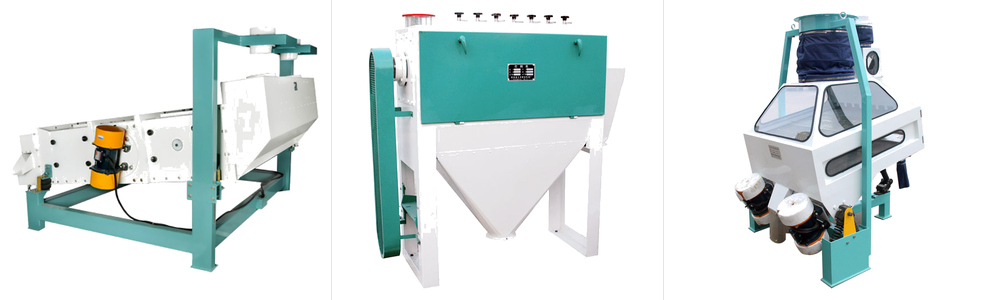
Cleaning Section, Left to Right: Pre-Cleaning Sieve, Scourer, Gravity Destoner.
Wheat Tempering Equipment: Water, Time and Bins
Tempering decides how bran breaks under the rolls. Bran at the right moisture is tough and lifts off in flakes. Bran that is too dry shatters, and the fragments are fine enough to pass the sifter into the flour and cannot be taken out afterwards. Under-tempering therefore costs twice: the endosperm is not released cleanly, and the fragments that do break off contaminate the flour. In the wheat milling process the published basis on this site is 12–18 hours for soft wheat and 18–24 hours for durum, with moisture into the mill held at 14%–16% and controlled within 0.3%. Wheat from different origins needs separate settings; running several origins through one line on a single compromise setting is the most common source of invisible loss.
The Egypt data quantifies this. Local wheat there is extremely dry at 9%–10% moisture, and the conclusion published on the site is that stable moisture control directly raises extraction by 1%–1.5%. For a 100 t/d flour milling plant, 1.5 points is 1.5 tonnes of finished flour a day, and the cost of getting it is simply doing tempering properly.Bring your consultant or your mill manager into the conversation — we work with both. Click the button below to arrange the call with your team.
Wheat Roller Mill: Break and Reduction Passes
Roll passages decide how much comes off at each stage. Flute design, speed differential and gap together set the release efficiency per passage and the amount of bran crushed in the process. A worn flute polishes rather than scrapes, and the endosperm stays on the bran and leaves the system with it. Wear is gradual, slow enough that no single event marks it, so it can only be tracked against a grinding schedule — feel is not a measurement. The site's notes on the pneumatic flour mill used in this wheat flour milling equipment treat the break-to-reduction ratio as an adjustable item: changing it lifts semolina yield while holding ash within 0.65%–0.9%.
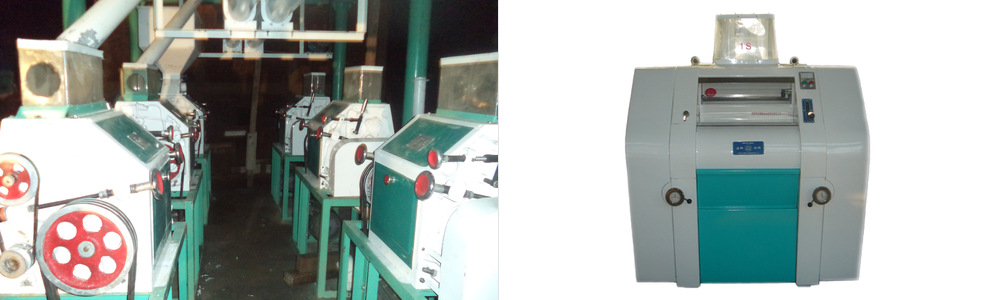
Roller mill section. Left: pneumatic mills in a row on a 30 t/d wheat line; right: a single unit of the same model.
Wheat Purifier and Plansifter
Purification decides where bran-carrying stock goes. A purifier grades particles by size and density in an air stream, lifting clean endosperm away from particles still carrying bran. Stock that bypasses it carries its bran into the reduction system, where it is ground finer until it can no longer be sifted out, and the batch has to be downgraded or blended down. One published flour milling equipment figure gives the scale: at the 100 t/d Egypt project, the purification stage cuts ash by 60%–70%. A purifier fails quietly — with the wrong air setting it still moves stock, so it looks like it is working while separating nothing. Air balance belongs on the daily check list, not the fault list.
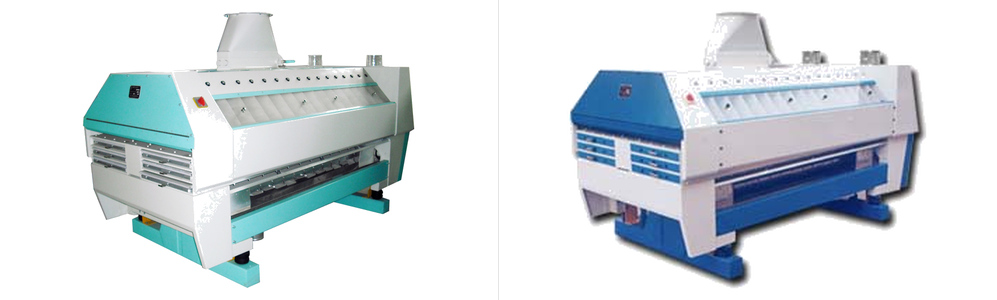
Purifiers. Left: the main unit in the purification section; right: the smaller model supplied with compact lines, separating by air rather than by sieve.
Bran Finisher and Flour Packing Machine
Bran finishing decides how much this wheat flour milling equipment recovers at the end. Flour adhering to bran leaves the mill priced as bran unless it is recovered. The finisher releases it and returns it to the flour streams, so its output is a direct addition to extraction rather than a marginal gain. In most mills this is the cheapest item of flour milling equipment available: the equipment is already installed and the fault is usually a setting or a routing error — which means saleable flour is being sold as bran every day. The equipment note is on the bran finisher.
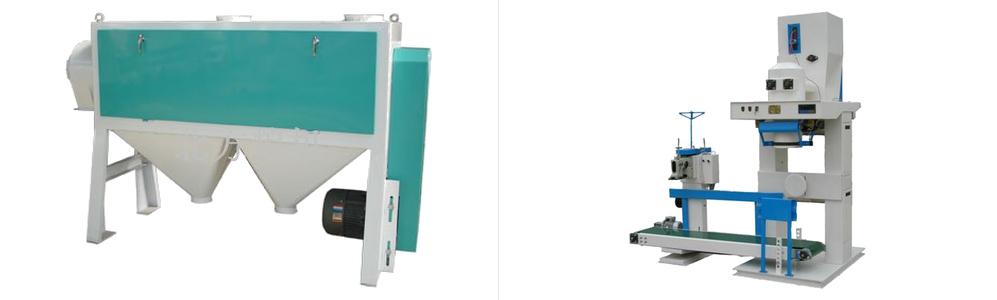
Left: The Finisher Recovers Flour Adhering to Bran; Right: The Automatic Packer
Read as a chain, the five flour milling equipment stages give a counter-intuitive conclusion: separating equipment such as the square plansifter and the purifier contributes more to extraction than the mill itself. The rolls can only detach endosperm from bran; whether what has been detached is then separated cleanly depends on sifting and purification. That is why the same roller mill list, paired with different sifting area, can differ by several points of extraction.
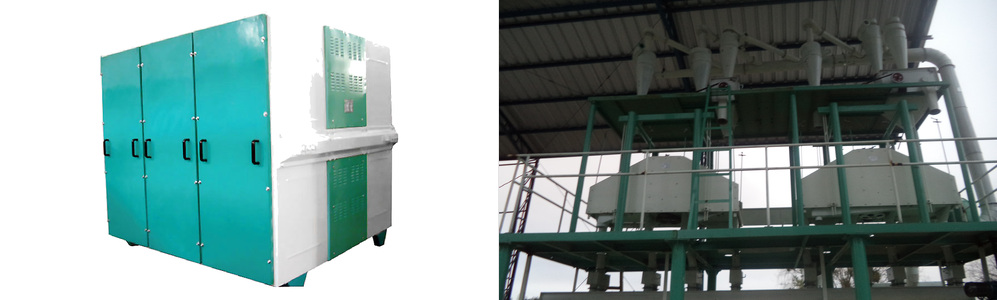
Sifting Section. Left: Square Plansifter as Supplied; Right: Installed on The Sifting Floor
Describe the problem in your current mill; the reply comes back as process parameters, not general advice. Click the button below and state the symptom in one line.
Wheat Flour Milling Machine Price: Why Quotes Differ
Those same five places are where the basis gets adjusted. Same machines, same wheat, different settings in those five stages, and the number quoted changes — which is not fraud, it is a choice. The problem is that a quotation never states which choice was made.
To see why the figures cannot be compared, go back to the term itself. Flour extraction rate is the weight of finished flour divided by the weight of wheat entering the mill. The numerator is straightforward. The denominator is where the argument starts. It should be the cleaned wheat after screening, destoning and scouring, not the gross weight of the truck at the gate. Mixing the two is the most common reason a flour milling plant's own figure disagrees with its supplier's, and the error moves with the cleanliness of incoming loads — which makes it look like a milling problem when it is a purchasing problem.
Extraction Rate Basis: Dirty Wheat, Clean Wheat, Grade
Three denominators are in use for flour extraction rate and they are not interchangeable:
-
Against dirty wheat. Cleaning losses are folded into the milling figure and the number drifts with foreign matter — it measures purchasing quality, not milling.
-
Against cleaned wheat. This measures the milling process itself, and it is the only basis on which equipment and process can be judged.
-
Against a specific grade. This measures how much of the output sells at that grade, usually below total extraction because some streams go to other products.
The table below puts every extraction figure published across this site side by side. All of them are labelled "extraction rate", the range runs from 60% to 85%, and capacity moves in the opposite direction to the number.
|
Page type |
Capacity |
Stated extraction |
What the basis is |
|---|---|---|---|
|
10 t/d |
F1 flour 60%, F2 flour 70%, standard flour 78% |
Three grades, listed separately |
|
|
20 t/d |
85% |
Single-machine sample |
|
|
20–30 t/d |
80–85% |
Single-machine sample, range |
|
|
30 t/d |
around 75% |
Measured after commissioning |
|
|
60 t/d |
75–80% |
Measured after commissioning |
|
|
100 t/d |
70–75% |
Measured after commissioning |
|
|
300–500 t/d |
70–75% |
Measured after commissioning, half Chinese and half Australian wheat |
|
|
Ethiopia proposal (three energy tiers) |
— |
72–75% / 74–78% / 76–79% |
Banded by energy-efficiency grade under the national energy specification |
|
— |
60–63% / 70–73% / 75–78% |
Banded by grade, variety not restricted |
|
|
— |
60.9%–77.3% |
Variety and grade effects combined |
|
|
— |
78–82% |
The page states outright that 85%+ is not realistic |
Four things follow from this flour extraction rate comparison, and each one can be used on a quotation the same day.
-
Capacity moves against the number. 85% at 20 t/d and 70–75% at 500 t/d is not a small mill beating a large one: more grading stages and a longer purification section push extraction up, not down. The gap is the grade basis, and the next point proves it.
-
One machine, three grades, 18 points apart. The 10 t/d page states its basis most clearly: F1 flour at 60%, F2 at 70%, standard flour at 78%. A figure without a grade attached carries no information.
-
A PLC switches 10 points. The Egypt page describes a switch between 72% and 82%. If the line can switch, both numbers are true — they describe different products being sold.
-
The maize page rejects a high number. It states that 85%+ is not realistic and gives 78–82% as the commercial range, because bran makes up a larger natural fraction. Refusing a high figure on another raw material is a sign the writer knows where the figure comes from.
Design Value or Measured Value
A quotation rarely states which one it is. A design figure is calculated against standard wheat; a measured result comes from one project, in one year, on one batch. The design figure usually looks better because the wheat is assumed clean and the moisture assumed right. There is one way to tell them apart: ask which country, which year and what wheat. If the answer cannot supply all three, treat the number as a reference.
Three questions to ask before comparing quotations
-
1. Is the denominator dirty wheat or cleaned wheat?
-
2. Which grade does it refer to, and what is the ash ceiling?
-
3. Is it measured after commissioning, or is it a design figure? Without all three answers the number cannot be used to compare, only to rank.
The three questions matter because one equipment list can support several true figures. A buyer who compares unqualified percentages ends up comparing two companies' quotation habits rather than their equipment.Sizing from raw wheat and target grade, then pricing section by section, is the only arrangement that holds. The four bands differ mainly in roll count, sifting area and whether purification stands alone — not in motor size.
- What is a normal flour extraction rate for a wheat flour milling process?
- There is no single figure for a flour milling plant. It depends on wheat variety, the grade being produced and the length of the mill's flow. Measured values published on this site run from 70% to 80%: Chile 30 t/d at around 75%, Algeria 60 t/d at 75–80%, and both Egypt 100 t/d and China 300–500 t/d at 70–75%. The 85% that appears on single-machine product pages is usually a standard-flour or wholemeal basis, which is not the same thing as graded flour.
- Why do suppliers quote such different extraction rates?
- Most of the difference in a flour extraction rate is the denominator or the grade, not the equipment. Measured against dirty wheat, cleaning losses are folded in; measured against cleaned wheat, the figure reflects milling alone. Between F1 flour and standard flour, the same machine can differ by 18 percentage points. Before comparing quotations, settle three things: denominator, grade, and ash ceiling.
- Is a higher extraction rate always better?
- No. The extra flour comes from endosperm attached to bran, and releasing it means scraping harder and grinding finer, so fine bran particles pass the sifter and raise ash. The Algeria market page on this site gives 0.65%–0.9% as the ash range for durum semolina, and above that the flour no longer sells at the same price. A market that pays for premium flour would rather have 70% at low ash than 80% at high ash.
- How is extraction rate calculated?
- A flour extraction rate is finished flour weight divided by cleaned wheat weight, both taken over the same period, with the numerator and denominator on the same basis. A daily material balance is also needed: flour plus bran plus offal should reconcile with the wheat input after allowing for moisture loss. If it does not, the weighing is wrong and the extraction figure cannot be trusted.
- Can extraction be improved without new flour milling equipment?
- In most mills, yes. An article on this site states that on the same wheat and the same line, extraction differs by 2% depending on how well the machine is operated. Those two points come from tempering, sifter air balance, roll scheduling and bran finisher routing — all maintenance and setting items, not capital items. Check those four before considering more equipment.
- How long should tempering take in the wheat milling process?
- The published basis on this site is 12–18 hours for soft wheat and 18–24 hours for durum, with moisture into the mill at 14%–16% and controlled within 0.3%. Time and temperature vary with variety, so wheat from different origins needs separate settings. Running several origins through one line on a single compromise setting is the most common source of invisible loss.
- How much difference does the purifier make?
- It shows up in ash more than in tonnage. At the 100 t/d Egypt project, the purification stage cuts ash by 60%–70%. A purifier fails quietly: with the wrong air setting it still moves stock and looks like it is working while separating nothing. Bran-carrying stock then reaches the reduction system, is ground too fine to sift out, and the batch has to be downgraded or blended. Air balance is a daily check, not a fault item.
- Why is power quoted as 65 kWh in one place and 88 kWh in another?
- A flour extraction rate has to be read with power per tonne, and the two use different denominators. The Tanzania market page gives 65–75 kWh per tonne of flour; the Ethiopia proposal gives 75–85 kWh per tonne of wheat. At 75% extraction, 88 kWh/t wheat and 66 kWh/t flour are the same statement. Compare the two directly and you will conclude that one supplier is more efficient when nothing has changed but the units.
- What should I send a flour milling equipment supplier for a quotation?
- Six items: target grade and ash ceiling, daily cleaned wheat and running hours, wheat origin with moisture and test weight, product mix by grade and rough proportion, available floor height and area, and power supply conditions. Miss one and the extraction rate you receive can only be an industry reference value, not an answer about your mill, and the quotations cannot be compared line by line.

Projects