 Build Your Future!
As a maize processing equipment supplier, ABC Machinery provides maize flour production lines from 5 to 50 t/d, specified against three inputs: target granulation, daily output, and whether meal and flour are both required.
Line Configuration: Capacity, Equipment and What Sets the Difference
Capacity is not the first decision. The first decision is what the maize processing plant has to sell, because that sets the sifting area, the sifting area sets the number of floors, and the floors set the building. Tonnage follows.
|
Capacity |
Line type |
Typical application |
Configuration |
What limits it |
|---|---|---|---|---|
|
5–10 t/d |
Compact maize milling plant |
Town or district supply, single product |
Combined machines, one plansifter |
Sieve area on a single frame |
|
20–30 t/d |
Standard maize flour production line |
Regional distribution, one or two products |
Separated sections, diverter, two bins |
Number of sifting floors available |
|
50 t/d and above |
Industrial corn milling plant |
Multi-grade supply, continuous operation |
Parallel sections, pneumatic conveying |
Roll stands and conveying capacity per section |
-
The jump from 10 to 20 t/d is not a bigger motor. It is a second sifting position and a second finished bin, which means one more floor on the structure.
-
That is why building cost rises more steeply between those two bands than between 20 and 30, where the structure is already tall enough and the extra output comes from roll stands and sieve frames.
-
The 5–10 t/d band occupies roughly 80–120 m² and reaches production in 3–5 days after installation and commissioning; set that against the four to five steel levels a 20 t/d line needs, and the gap between the two routes is visible before any price is quoted.
The schedule below takes the middle band and specifies a 20 t/d maize flour production line twice — once as a meal line, once as a flour line — so the two can be compared row by row. Models and rated figures for this maize processing equipment are the ones published on this site.
|
# |
Machine |
Meal line |
Flour line |
Function |
|---|---|---|---|---|
|
1 |
Vibrating sieve |
One unit |
One unit |
Removes straw, cobs and large impurities |
|
2 |
Destoner |
TQSF125a, 12–15 t/h |
TQSF125a, 12–15 t/h |
Removes stones of similar size to the grain |
|
3 |
Magnetic separator |
One unit |
One unit |
Catches tramp iron before the rolls |
|
4 |
Conditioning bin |
Short retention |
Longer retention |
Holds grain after water is added |
|
5 |
Roller mill, break |
FMFQ25/80, Φ250×800 |
FMFQ25/80, full break |
Opens the grain and releases endosperm |
|
6 |
Roller mill, reduction |
Not required |
Two to three stands |
Reduces semolina to flour fineness |
|
7 |
Plansifter |
FSFG6×24C, 31.6–57.3 m² |
FSFG8×24H, 60.8–106.8 m² |
Sorts stock by particle size |
|
8 |
Purifier |
Not required |
FQFD49×2, 800–1200 kg/h |
Separates endosperm from bran-carrying stock |
|
9 |
Bran finisher |
Not required |
FPDW45×1, 1.3–1.5 t/h, 5.5 kW |
Recovers flour adhering to bran |
|
10 |
Bucket elevator |
Set, by lift height |
Set, more lifts |
Vertical transport between floors |
|
11 |
Dust collector |
TBLM, by air volume |
TBLM, larger air volume |
Controls dust at transfer points |
|
12 |
Packing machine |
One unit |
One, or two for two grades |
Weighs, fills and closes bags |
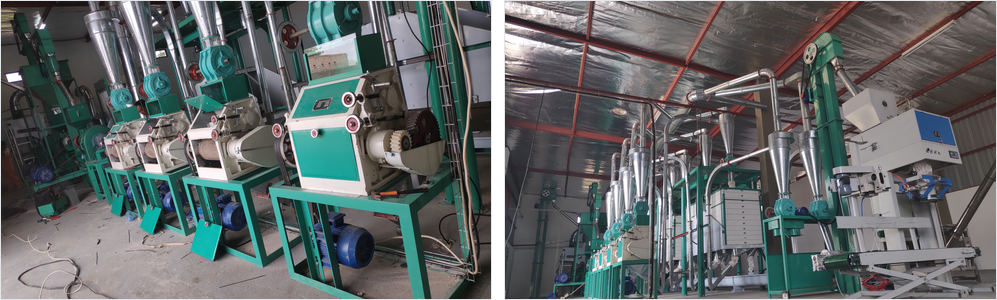
20 t/d maize line. Left: roller mill section during installation. Right: the same line seen from the packing end.
There is a set of ratios in that table that gets overlooked. A 20 t/d line running 20 hours a day works out at 1 t/h, while the destoner is rated 12–15 t/h, the purifier 800–1200 kg/h and the bran finisher 1.3–1.5 t/h. The cleaning section carries more than twelve times the margin; the milling section carries roughly double. That is not an error in sizing — cleaning machines are selected against the peak infeed and rolls and sieves against steady output, and the two should never be the same order of magnitude. It does mean, though, that the "capacity" figures on two machines in a quotation cannot be compared with each other.
Two rows carry most of the price difference. The purifier and the bran finisher appear only on the flour version, and their absence on a meal line is a process decision rather than a reduction in specification: bran stays in the product, so there is nothing to separate and nothing to recover. Removing them from a flour line to save cost does not produce a cheaper flour line — it produces a meal line labelled as flour.
Read the table backwards when comparing quotations. Three omissions account for most of the gap between a low bid and a complete one: a missing destoner, a single plansifter where two are specified, and a packing section without a weighing head. None of them appear on the quotation as a missing line, because they were never priced. Ask for the equipment list, not the tonnage. One reference point for calibration: maize processing equipment normally takes 60–70% of total plant investment, with civil works at 10–15%. If a quotation sits well below that share, the missing items are usually of this kind.Tell us your target capacity and raw grain; the reply is an itemised line configuration, not a brochure. Click the button below to send your capacity and grain type.

The Maize Milling Process: Five Sections, and What Each One Decides
The maize milling process runs through five sections in a fixed order, and each one removes a specific risk rather than simply moving grain. The table below sets them side by side, with sifting and packing shown in one column because they share a floor; what follows is what each section does and the failure it prevents.
|
Aspect |
Cleaning |
Conditioning |
Degermination |
Sifting and packing |
|---|---|---|---|---|
|
Core machine |
Vibrating sieve, destoner, magnet |
Conditioning bin |
Break rolls, germ screen |
Plansifter, purifier, reduction rolls, packer |
|
What it removes |
Cobs, glumes, silk, sand, stones, iron |
Brittleness in bran and endosperm |
Germ and its oil |
Off-size particles, flour still on bran |
|
If it is skipped |
Scored roll castings, grit in the product |
Fine bran powder in flour, shorter sieve life |
Rancidity in storage, oil smeared on rolls |
Inconsistent granulation, flour lost to bran |
Cleaning. Maize carries impurities wheat does not: cob fragments, glumes, silk, and a heavier sand load because the ear sits close to the ground. The vibrating sieve takes the coarse fraction, the destoner takes stones of near-grain size, the magnet takes tramp iron. A single cleaning stage removes about 95% of impurities; running several stages lifts that to 97–98% and improves finished-flour consistency by 10–15%. Two or three points sounds small, but it decides whether the product clears a buyer's acceptance line every week or only most weeks. Cleaning and hulling equipment is sized against peak infeed, which is why a destoner's throughput sits an order of magnitude above the line's rated capacity.
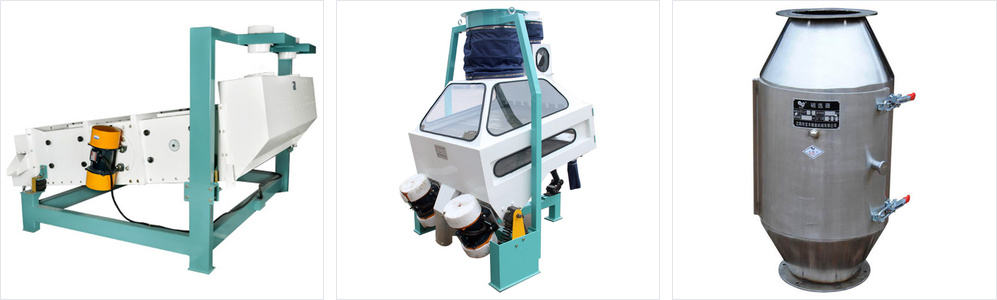
Cleaning section, left to right: vibrating sieve, gravity destoner, magnetic separator.
Conditioning. Water is added and the grain rests before breaking, typically for 10 to 30 minutes. The purpose is a moisture differential: bran toughens and flakes instead of shattering into the flour, while endosperm softens and fractures cleanly. A line run dry puts more fine bran powder into the flour and shortens sifter life. Retention time is a property of the bin, which is why the bin is a separate row in the schedule. Whether a line runs dry or with conditioning is a process choice with its own trade-offs, set out in dry versus semi-wet corn milling.
Degermination and breaking. The germ is roughly a tenth of kernel weight and carries over 30% oil on a dry basis — a figure general to maize rather than specific to any supplier's machine. Left in the product that oil goes rancid in storage, and on a flour line it smears on the rolls. The sharper cost is in extraction: incomplete degermination drops the extraction rate by 3 to 6 percentage points, and that is a straight loss that later parameter tuning does not recover. Fat content runs opposite to particle size — large germ-free grits sit below 0.5% fat while the finest flour fraction reaches 1.5–2.5% — so the finer the product, the less this step can be trimmed. Breaking is therefore staged: early passages open the kernel and liberate the germ, which is screened off; later passages reduce what remains. Whether germ is sold as a by-product or discarded with the bran is a commercial decision made before the flowsheet is drawn.
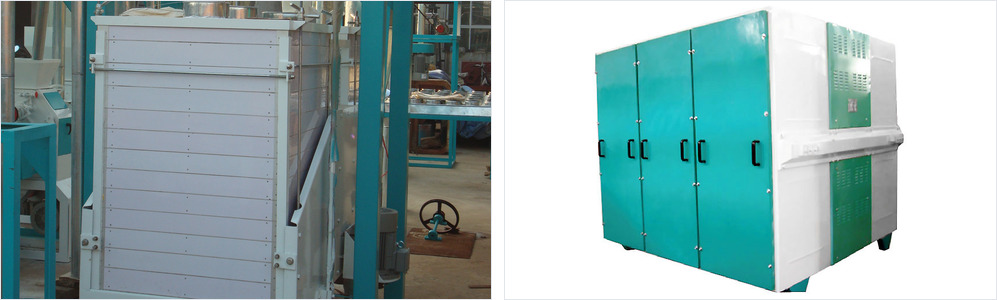
Square plansifter. Left: installed on the sifting floor. Right: the same machine as supplied.
Sifting and reduction. The plansifter is the sorting centre. Stock from each break passage is graded by particle size: coarse returns to a roll stand, fine moves forward, and the intermediate fraction — semolina — goes to the purifier where the line has one. Sifting area sets capacity: an FSFG6×24C at 31.6–57.3 m² and an FSFG8×24H at 60.8–106.8 m². Converted, a 20 t/d line therefore carries 1.6 to 2.9 m² of sieve area per daily tonne, and that ratio is the fastest way to tell whether a proposed configuration is generous or tight. Reduction stands grind semolina to flour fineness; a meal line stops before this step because the target particle size is coarser. Super-white maize flour in East Africa spans an extraction rate of 73–92%, and a spread that wide comes entirely from equipment configuration and settings rather than from the grain.
Packing accuracy gets treated as a detail. The 50 t/d corn and wheat line built in Zambia uses automatic weighing and packing across four bag sizes — 5, 10, 25 and 50 kg — with measurement held within ±0.2%. At 20 t/d, 0.2% is 40 kg a day of deviation; let the figure drift to 1% and it becomes 200 kg a day, which is a visible line item over a year.
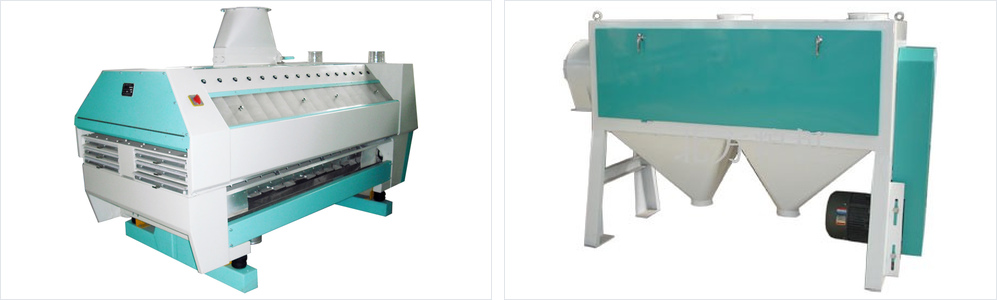
Flour line additions. Left: purifier. Right: bran finisher.
Granulation is where buyers and suppliers most often talk past each other. A line making meal for ugali, one making meal for nshima and one making flour for baking are all called maize mills, but the sieve aperture defining the finished product differs, and the aperture is set by the buyer's market rather than by the machine. Specify the aperture, or name the end product and the country, and the sifter configuration follows. Specifying only "maize flour" leaves the most consequential variable undecided.Four fields are enough to open a quote file: grain, capacity, destination port, timeline. Click the button below and fill the four fields.
Why Choose ABC Machinery as Your Maize Flour Production Partner?
Published figures from completed maize processing plants are the most useful thing a buyer can carry into a budget, because they come from a line that ran. As a maize processing equipment supplier, ABC Machinery has two maize flour production lines described on this site — a 60 t/d mill in Zambia and an 80 t/d plant in Uganda — and the figures follow.
|
Item |
60 t/d maize mill, Zambia |
80 t/d maize flour and grits plant, Uganda |
|---|---|---|
|
Year built |
2013 |
2009, at Kampala |
|
Product mix |
Maize meal for nshima |
Flour 30–35%, grits 40–45% |
|
Roll stands |
Six sets, 2250 manual rolls |
Staged break and reduction |
|
Connected load |
About 120 kW |
Not published |
|
Energy per tonne |
48 kWh per tonne of maize |
Not published |
|
Labour |
Three shifts, five workers per shift (15 in total) |
Not published |
|
Structure |
Multi-storey, steel frame |
Full steel structure |
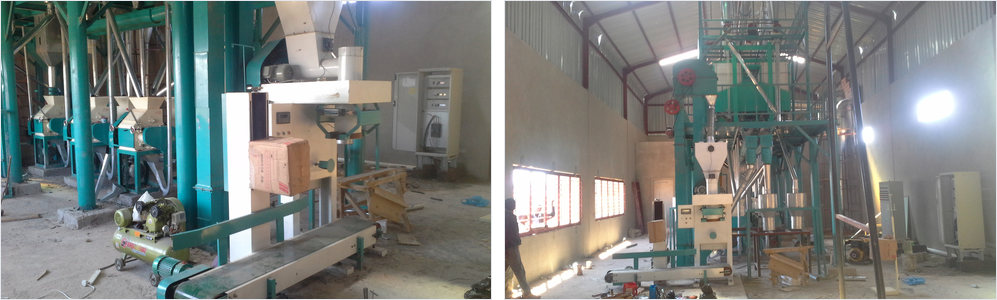
Packing section of an installed maize line. Left: weighing head, filled bag and discharge conveyor. Right: the same mill floor seen from the door.
The Uganda mix is the second figure worth keeping. Flour at 30–35% and grits at 40–45% means the line is not optimised for one product — the balance of the kernel goes to grits, bran and germ. A buyer planning a dual-product plant, and choosing maize processing equipment against it, should expect a similar split rather than a flour yield comparable to a wheat mill, and should price the project against both revenue streams. Operating costs for maize milling in that market are treated in more detail under maize milling in Uganda.
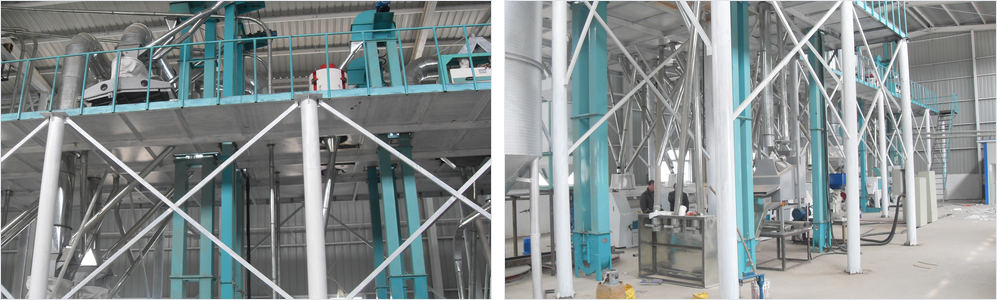
Steel structure on an 80 t/d line. Left: under the mill floor. Right: the mill hall beyond it.
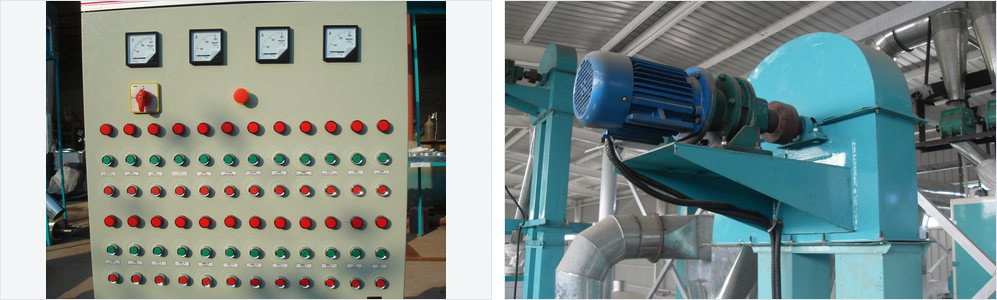
Left: line control cabinet. Right: fan and drive motor serving the milling line.
To equip a maize processing plant and get a comparable price, send six items: target granulation and sieve aperture, daily output and operating hours, whether both products are required, whether germ is to be recovered, available building height, and the power supply. A configuration and an equipment list can be prepared against those six without further clarification, and quotations from different suppliers can then be compared line by line instead of by headline tonnage. If all you need is the order of magnitude of a maize processing equipment price, the table above is enough; if the number has to stand up in a contract, none of the six can be left out.
As a maize processing equipment supplier, ABC Machinery also provides FMFQ roller mills and packing machines. Related reading: turnkey flour mill solutions for African investors, maize flour and grits market analysis, maize flour plant in Kenya. Related project: 50 t/d corn and wheat line in Zambia.
- What capacity does a maize flour production line start from?
- Compact lines start at 5 t/d and the standard range runs to 50 t/d, with parallel sections above that. The smallest practical configuration is limited by sifting area rather than by the roller mill. The 5–10 t/d band occupies about 80–120 m² and reaches production in 3–5 days.
- How much does a 20 t/d maize processing plant cost?
- On published Kenya market references, maize processing equipment price at 20 t/d sits between KES 1,800,000 and 2,700,000, varying ±12%. At the same output, the gap between a meal line and a flour line comes mainly from the purifier, the bran finisher and the second sifting stage. Send the six specification items and it can be priced against them.
- How much power does a maize mill use per tonne?
- Two published figures on this site disagree: the 60 t/d line in Zambia measured 48 kWh per tonne, while a technical note for the 10–50 t/d scale gives 15–25 kWh per tonne. The difference probably reflects whether cleaning, conveying, dust collection and packing are inside the boundary. For budgeting, take 48 kWh per tonne and leave the margin, then ask for a load breakdown by section.
- Why is the germ removed?
- The germ is roughly a tenth of kernel weight and carries over 30% oil on a dry basis. Left in the product it goes rancid in storage, and on a flour line it smears on the rolls. The sharper cost is extraction — incomplete degermination drops it by 3 to 6 percentage points. Large grits sit below 0.5% fat and the finest flour fraction reaches 1.5–2.5%, so the finer the product, the less this step can be trimmed.
- What maize processing equipment does a maize flour production line include?
- Cleaning is a vibrating sieve, destoner and magnet; milling is roller mills, a plansifter and a purifier; the back end is a bran finisher, dust collector and packer. A flour line adds reduction rolls, the purifier, the bran finisher and a second sifting stage, and those four are where the price difference between a meal line and a flour line comes from.
- Can the same line produce maize meal and maize flour?
- Yes, with a diverter on the break stock, replaceable sifter frames and two separately routed finished bins. All four items, including the second packing point, must be designed in before construction.
- What building height is needed?
- It depends on the number of sifting stages. A meal-only line sometimes fits one floor lower than a flour line of the same output; a dual-product line usually needs the full height because it carries both flows. Lines above 20 t/d are normally four to five levels.
- Is installation included?
- Mechanical erection and commissioning can be handled by an assembly team sent to site, or left to a local contractor; the choice changes the price. Civil works, foundations and the electrical connection to the control cabinet remain with the buyer either way.
- How long is delivery?
- Delivery depends on the equipment list and on the shipping route; the schedule is confirmed in the quotation rather than assumed.



Projects