 Build Your Future!
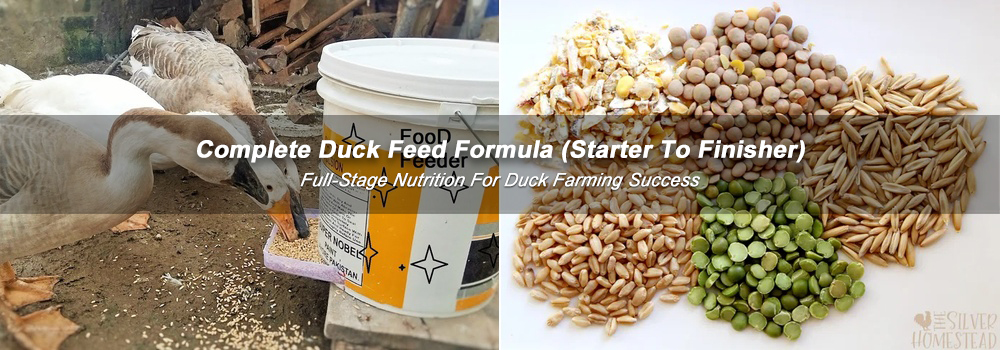
Complete Duck Feed Formula Guide
Typical Duck Feed Formulations Across Growth Stages
Duck diets require higher fiber tolerance, more sulfur amino acids, and flexible energy adjustments due to water-based activity and rapid early growth. The formulas below reflect practical ratios used in commercial duck farms.
- Starter Formula (0–2 Weeks): 46–50% Corn, 20–24% Soybean Meal, 10–14% Broken Rice/Wheat, 6–8% Fish Meal, 3–4% Soybean Oil, 1.8–2.0% Dicalcium Phosphate, 1.0–1.2% Limestone, 0.5% Premix, 0.30–0.40% Methionine + Lysine
- Grower Formula (2–6 Weeks): 50–55% Corn, 18–22% Soybean Meal, 12–16% Wheat Bran/DDGS, 4–5% Soybean Oil, 2–3% Animal Protein (Fish Meal/MBM), 1.5–1.7% DCP, 0.9–1.1% Limestone, 0.5% Premix, 0.22–0.32% Synthetic Amino Acids
- Finisher Formula (6 Weeks to Market): 55–60% Corn, 15–18% Soybean Meal, 15–20% Wheat Bran/DDGS, 3–4% Oil/Fat, 1–2% Animal Protein, 1.2–1.4% DCP, 0.8–1.0% Limestone, 0.5% Premix, 0.15–0.25% Met + Lys
Duck production systems rely on systematic poultry feed formulation frameworks to achieve predictable growth, efficient feed conversion, and stable plant operations. A full-stage duck feed formula must integrate nutrient modeling, ingredient availability, and process engineering to ensure consistent output in commercial conditions. Properly structured formulas also support feed mill plants aiming to maintain cost efficiency across 8–12 t/h production lines and reduce formulation deviations to below 1.5%.

Duck Feed Formulation Parameters Across Growth Stages
Early-Stage Energy–Protein Alignment
Starter ducks require nutrient densities approximately 15–20% higher than growers because body weight increases rapidly from 40 g to over 350 g during the first 10 days. Aligning duck feed formulation by growth stage with metabolic demands helps maintain predictable live-weight gain (LWG). Metabolizable energy (ME) typically ranges from 2,850–2,950 kcal/kg in starters, while crude protein (CP) stays between 20–22%. Grower formulas gradually reduce CP to 17–19% as feed intake rises from 60 g/day to more than 150 g/day.
Ingredient Specification And Raw Material Quality
Corn, wheat, soybean meal, and rice bran represent over 80% of standard commercial diets. Each ingredient’s technical index—including urease activity (<0.10 pH rise), bulk density (650–750 kg/m³), and particle size (Dgw 450–650 µm)—directly affects nutrient utilization. When designing a duck feed formula, feed mills must also incorporate Near-Infrared Reflectance (NIR, Near-Infrared Reflectance) calibration curves to monitor protein deviations within ±0.5%. (Related Post: Poultry Feed Ingredients Overview>>)
Growth Performance Correlation
Feed conversion ratio (FCR) for commercial ducks typically ranges from 1.80–2.30 between 0–42 days. Nutrient models should reflect this relationship: every 1% drop in CP can reduce average daily gain (ADG) by 1.5–2.0 g/day. Similarly, reducing metabolizable energy by 50 kcal/kg may increase intake by 3–5 g/day, affecting pellet durability and formulation density.
Digestive Maturity And Formula Shift
Adjustments must match digestive enzyme development and gut-absorption maturation occurring rapidly between days 7–21. During this period, crude fiber levels should remain below 5%, while AME variability must be controlled within 35 kcal/kg to prevent growth suppression.
Growth Model Consideration
The nutrient-to-energy ratio should follow the declining protein-to-energy requirement as ducks transition from starter to finisher phases. A 6–10% decline in CP between stages reduces amino acid oversupply and lowers feed cost by 20–35 USD/ton depending on regional prices.
Commercial feed mills should also apply Manufacturing Execution System (MES, Manufacturing Execution System) tracking to ensure moisture levels stay within 11.5–12.8% at bagging to avoid storage mold growth.
| Growth Stage | ME (kcal/kg) | CP (%) | Ca (%) | Available P (%) | Typical Intake (g/day) |
|---|---|---|---|---|---|
| Starter (0–10 d) | 2,900 | 21.0 | 0.85 | 0.45 | 40–70 |
| Grower (11–25 d) | 2,850 | 19.0 | 0.75 | 0.40 | 90–150 |
| Finisher (26–42 d) | 2,800 | 17.5 | 0.70 | 0.35 | 160–220 |
Unlock performance gains in commercial duck feed production—connect with our feed-mill engineering specialists to design a full-stage nutrition strategy tailored to your plant.
Commercial Duck Feed Production Line Design And Process Control
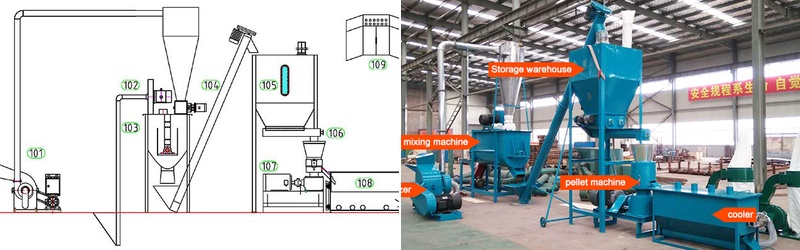
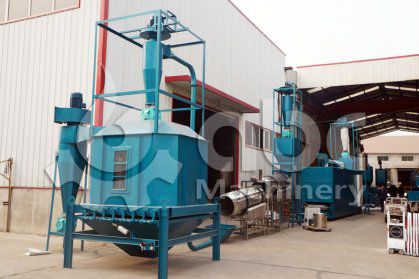
Small Feed Production Line (for Home/Farm Use)
Precise grinding, mixing, and pelleting parameters ensure consistent nutrient distribution. Maintaining mixing uniformity at a coefficient of variation (CV) ≤10% ensures that each 50 kg batch meets predictable nutrient accuracy. Incorporating duck feed plant process design considerations helps stabilize capacity across 6–20 t/h production lines.
Particle size for duck feed typically ranges between 550–650 µm for balanced digestibility and pellet strength. Pelleting temperatures should target 78–82 °C, with conditioning time of 12–18 seconds to ensure durability. These pelleting parameters for duck feed reduce fines to below 10%. Maintaining mixing uniformity in duck feed production is essential for amino acid and vitamin distribution since micro-ingredient deviation of even 0.1 g/kg can impact growth performance.
Get your customized process-engineering layout for a stable and efficient duck feed production line—contact our design team.

Cost-Effective Ingredient Strategies For Stable Duck Feed Production
Formulating a cost-effective duck feed ingredients strategy requires balancing nutrition with market volatility. Soybean meal prices may fluctuate by 30–60 USD/ton monthly, making partial replacement with alternative raw materials for duck feed such as canola meal, coconut meal, or rice DDGS (up to 10%) an effective approach. Under this framework, ingredient risk management in feed formulation helps maintain nutrient stability even when supply chains shift.
Feed mills can reduce total formula cost by 3–7% by applying multi-source energy inputs and applying quarterly ingredient matrix updates. Ensuring suppliers maintain protein deviations at ≤0.5% and moisture variations at ≤1% safeguards consistent nutrient delivery.
Partner with us to develop a supply-stabilized ingredient strategy that protects your production costs throughout the year.
Quality Testing And Finished-Feed Optimization In Commercial Duck Feed Formulas
Quality control ensures that each duck feed formula meets nutrient expectations after pelleting. Routine duck feed quality control tests include proximate analysis, amino acid profiling, and NIR verification. Pellet durability index (PDI) should maintain 88–92%, while moisture levels remain between 11.5–12.5% depending on climate.
Monitoring pellet quality indicators for duck feed—such as hardness (2.5–3.0 kg), fines percentage (<10%), and temperature drop across cooling (<8 °C)—helps maintain consistency. Different regional markets may require adjustments to meet poultry feed optimization for market requirements, such as pellet size preferences of 2.5–3.0 mm.
Maintaining CP deviations below 0.6% and energy deviations below 40 kcal/kg improves flock performance consistency across different farms.
Consult our quality-engineering team to build a testing protocol that elevates your finished duck feed consistency and market competitiveness.
The principles of poultry feed formulation remain central across all stages of designing a full-cycle duck feed formula, ensuring predictable performance, cost stability, and efficient plant operation.