 Build Your Future!
-
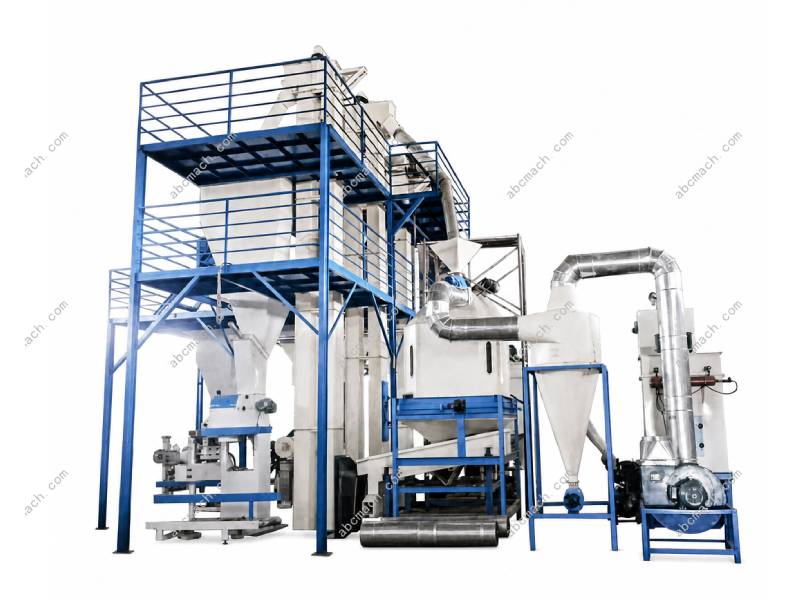
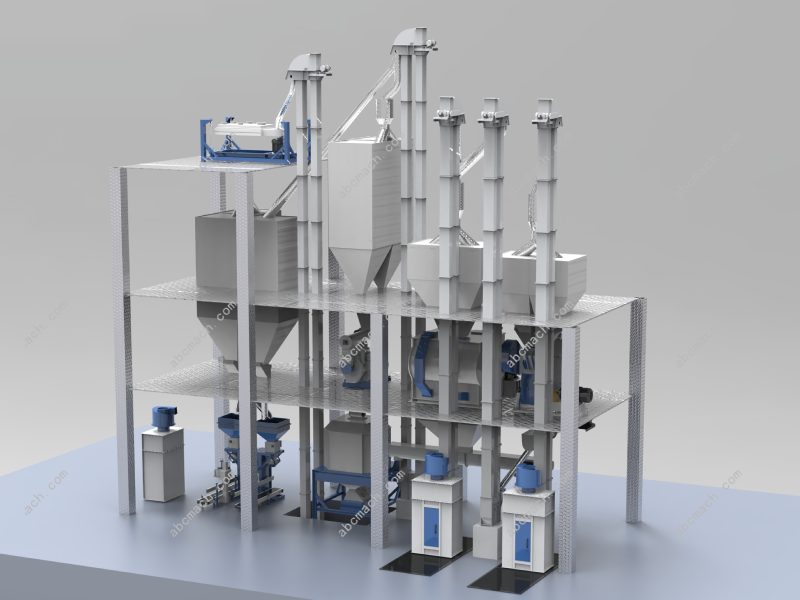
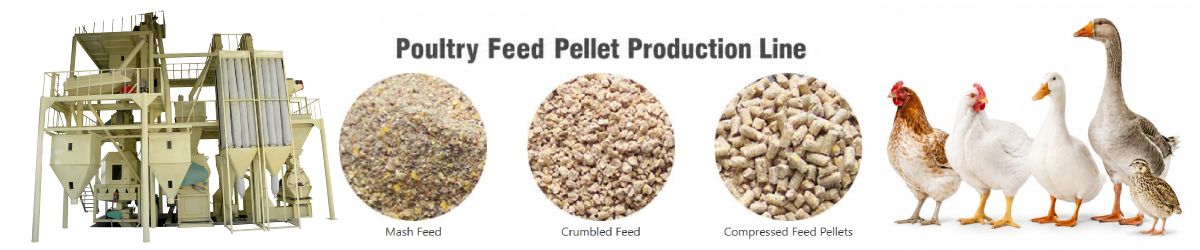
Complete feed processing coverage: A poultry feed pellet production line converts corn, soybean meal and other raw materials into uniform, nutrient-dense pellets for chickens, layers, broilers, chicks, ducks, quail, pigeon and so on.
-
Full specification toolkit: It covers the complete equipment chain, capacity selection from 1 t/h to 100 t/h, formulation and quality targets, supplier selection criteria and real export projects.
-
Fast navigation by species: Use the species-specific sections below to jump straight to the line that matches your operation, or read on for the full plant picture.
Build a Reliable Poultry Feed Manufacturing Plant for Your Business
Whether you are producing feed for your own poultry farm or planning to establish a commercial feed manufacturing business, investing in a poultry feed manufacturing plant is about more than purchasing equipment. A successful project starts with choosing the right production process, plant layout, and capacity to match your raw materials, target products, and future business plans.
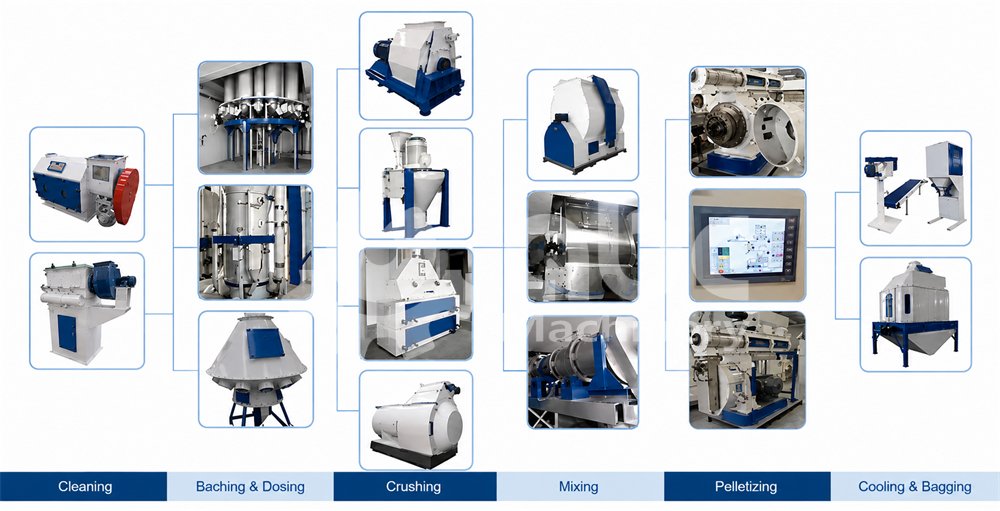
A modern poultry feed production line converts grains, protein meals, vitamins, and mineral additives into high-quality poultry feed through grinding, batching, mixing, pelleting, cooling, and packaging. When these processes are properly integrated, manufacturers can achieve consistent feed quality, higher production efficiency, and lower operating costs.
Complete Poultry Feed Making Equipment for Feed Commerical Business
Poultry Feed Lines by Specie: One Base Line, Customize Configurations
The different poultry species can share one base production line, just fitting your full-spectrum poultry feed manufacturing business needs. . The differences are die diameter, crumbler on/off, grinding size, conditioning temperature and formula:| Feed type | Preferred output | Die diameter | Crumbler | Key process point |
|---|---|---|---|---|
| Layer feed | Mash (pellet optional) | 2.5–3.0 mm (optional) | No | Anti-segregation for calcium |
| Broiler feed | Whole pellet + starter crumble | 2.0–2.5 / 3.0–4.0 mm | Mandatory | Long conditioning, starch gelatinization |
| Chick starter feed | Crumble 1–1.5 mm | 2.0–2.5 mm | Mandatory | Gentle conditioning 75–80°C |
| Duck feed | Whole pellet | 2.5–4.0 mm | Optional (ducklings) | High compression ratio for hardness |
| Goose feed | Large pellet | 3.5–6.0 mm | No | High-fiber formula; capacity −20–30% |
| Quail feed | Micro-crumble 0.8–1.5 mm | 2.0–2.5 mm | Mandatory | Fine screening; tiny dies forbidden |
Complete Equipment Breakdown of a Poultry Feed Plant
| Stage | Equipment | Key specification |
|---|---|---|
| Receiving & cleaning | Sieve + magnetic separator | Remove stones, metal and impurities |
| Grinding | TPF hammer mill / 9FQ grinder | Grains to 2–6 mm depending on species |
| Batching | Batching scales + screw feeders | Formula-accurate dosing of every ingredient |
| Mixing | SLHY batch mixer | 1,000–4,000 kg/batch; CV ≤ 5% |
| Conditioning | Single or double-layer conditioner | 75–85°C depending on species |
| Pelletizing | BPM ring die pellet mill | 1–15 t/h per unit; dies 2.0–6.0 mm |
| Crumbling / screening | Crumbler + rotary screener | 1–1.5 mm crumble; fines removed |
| Cooling & bagging | Counter-flow cooler + bagging machine | Moisture to 11–12%; 25/50 kg bags |
At ABC Machinery, we provide complete poultry feed manufacturing solutions ranging from small on-farm feed mills to fully automatic commercial feed factories. Our engineering team supports customers throughout the entire project lifecycle, including process design, equipment manufacturing, installation, commissioning, operator training, and technical support.

Poultry Feed Formulations, Feed Mill Capacity & Global Project Cases
Raw Materials & Formulation Basics
-
Energy sources (50–60% of formula) — corn, wheat, sorghum at ME 3,200–3,400 kcal/kg; grinding size 3–5 mm.
-
Protein sources (20–30%) — soybean meal (44–48% CP), fish meal, sunflower and rapeseed meal; locally available substitutes such as full-fat soybean can replace part of the meal.
-
Minerals & additives(1–3%) — limestone and DCP for calcium and phosphorus, premix at 0.3–0.5%, enzymes at 0.01–0.05%.Quality gates — moisture 10–13%, impurities below 1%, aflatoxin below 20 ppb; feed stored above 14% moisture accelerates mold growth.
-
Species-specific formulas — layer calcium at 3.6–4.2%, broiler energy at 2,950–3,150 kcal/kg, chick starter protein at 20–22% — are documented in our [complete poultry feed formulation guide]and the [key poultry feed ingredients]reference.
Production Capacity Guide: From 1 t/h to 100 t/h
Lines are custom-engineered, not off-the-shelf — but the standard tiers below are where most projects start:
|
Capacity tier |
Typical operation |
Recommended equipment |
|---|---|---|
|
0.2–1 t/h |
Pet bird feed, chick starter, family farms |
ZLSP flat die, 60–800 kg/h; mini line to 1.1 t/h |
|
1–2 t/h |
10,000–30,000 layers; mini feed mills |
BPM250 / BPM25C ring die |
|
2–4 t/h |
100,000–200,000 broilers; medium mills |
BPM32B ring die |
|
4–8 t/h |
Commercial feed mills, branded feed |
BPM35B / BPM350 ring die |
|
8–30 t/h |
Industrial plants, contract manufacturing |
BPM40B / BPM45B, multi-line |
|
30–100 t/h |
Large factories, turnkey plants |
Custom multi-line engineering |
ABC Machinery's delivered portfolio covers the whole span — from a 1 t/h poultry feed line in Thailand to a 60,000 t/y (10 t/h) poultry feed milling line and industrial plants at the 250,000–600,000 t/y scale — so capacity is never the constraint when you plan with us. Setup cost scales with capacity and automation — a 1–2 t/h line costs a small fraction of an 8–10 t/h plant, and the gap is driven mainly by the pellet mill size, batching automation and steel structure. Tier-by-tier figures are documented in our [poultry feed mill setup cost by capacity tier] guide.
Export Track Record & Project References
Our poultry feed production lines operate across Africa, Asia and the Middle East — the projects below are documented with equipment lists and delivery details:
|
Project |
Country |
Capacity |
Highlight |
|---|---|---|---|
|
1 t/h poultry feed line |
Thailand |
1 t/h |
Starter/grower/layer feed with training |
|
Mash feed plant |
Kenya |
1–2 t/h |
Whole corn + soybean local formula |
|
Chicken feed mill equipment |
Bangladesh |
1–1.2 t/h |
Pre-shipment inspection report |
|
Poultry & livestock feed plant |
Tanzania |
2–3 t/h |
1-month installation; market CAGR 5.9% |
|
Turnkey feed pellet line |
Uzbekistan |
2–4 t/h |
Design-to-training in about 1 month |
|
Poultry feed manufacturing plant |
Uganda |
2 t/h |
Mash/crumble/pellet on one line |
|
Animal feed processing plant |
Mali |
3–5 t/h |
~25 t/day for cattle + poultry |
|
Poultry feed milling line |
— |
60,000 t/y |
10 t/h industrial reference line |
Why Invest in a Poultry Feed Pellet Production Line?
Feed accounts for 65–80% of poultry production cost, which makes the pelleting decision a direct profit lever rather than a processing detail.
-
Feed conversion — pelleted feed improves conversion by 10–12% versus mash, because birds cannot sort ingredients and consume every particle.
-
Bulk density — pellets increase bulk density by 40–100%, cutting storage space and freight cost by roughly a third to a half.
-
Feed safety — conditioning at 75–85°C reduces pathogens and mycotoxin risk, and reduces dust in the poultry house.
-
Self-mixing payback — farms producing their own feed typically save 6–12% versus purchased compound feed, with payback driven by flock size and local ingredient prices.
Get a Free Poultry Feed Line Quote
Before sending your inquiry, note down:
Bird type and inventory— layers, broilers, chicks, ducks, geese or quail, and the number.
Target capacity— t/h, or daily tonnage; we calculate it from flock size if unsure.
Output form— mash, crumble, pellets, or a mix (e.g. broiler starter crumble + grower pellets).
Formula or ingredients — your formula sheet, or the locally available raw materials.
Site and power — area available and whether electric, diesel or PTO drive is needed.
Send these details through our [online inquiry form] and you will receive a line design, equipment list and budget range within one working day — plus free formula guidance and layout drawings. For plants above 10 t/h, our engineers can also arrange a site survey.