 Build Your Future!
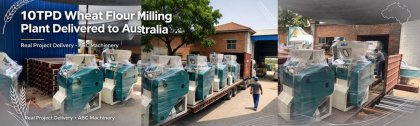
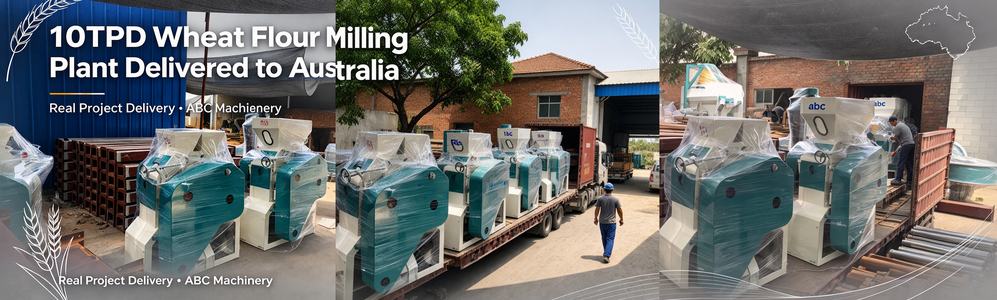
Most enquiries about a small wheat flour milling plant come down to one question: can a 10 t/day flour mill line actually hold a flour grade, or is it only good for coarse grinding? The answer is decided by how many process stages the set contains, not by how many tonnes it is rated for. This 10 t/day wheat flour milling plant was built for a client in Australia as a complete five-stage set. The flour mill equipment was assembled and trial-run on wheat at our factory, protected and packed for sea freight, then loaded into the container as a full set - so what arrives at the destination is a wheat flour milling line that has already been run on grain, not a stack of unassembled machines.
Project parameters
|
Parameter |
Details |
|---|---|
|
Raw material |
Wheat |
|
Rated capacity |
10 t / 24 h (approx. 0.42 t/h) |
|
Process stages |
5 - cleaning, scouring, destoning, roller milling, pneumatic lifting |
|
Project location |
Australia |
|
Equipment supplier |
ABC Machinery (complete set, one-stop) |
|
Service scope |
Process design -> manufacturing -> factory trial run -> export packing -> container loading |
|
Scope of supply |
Cleaning sieve x2, vertical wheat scourer, destoner, double roller mill, pneumatic flour lifting unit |
|
Delivery stage |
Factory tested, export packed and container loaded |
Performance the 10TPD wheat flour unit is built to hold
The table below lists the parameters that decide whether flour from this line can be sold as a graded product. Ranges are typical industry values; the values applied to your project are confirmed in the process design against your wheat and your target grade.
|
Indicator |
Typical value |
What sets it |
|---|---|---|
|
Wheat throughput |
10 t / 24 h (≈ 0.42 t/h) |
Line sizing, confirmed in process design |
|
Straight-grade flour extraction |
72–75% |
Wheat hardness, conditioning and the number of milling passages |
|
Refinement beyond 75% extraction |
Quality loss accelerates |
Classic milling behaviour — the last few points of extraction carry proportionally more bran |
|
Wheat conditioning moisture |
15.5–17.5%, rested 36–48 h |
Tempering before the mill |
|
Bran carry-over into flour |
Reduced by scouring before milling |
Scouring stage |
|
Stone and metal removal |
Before the rolls |
Density separation and magnetic separation |
|
Dust collection efficiency |
≥ 99.5% on our pneumatic lines |
Duct design, filter area and fan selection |
|
Repeatability between batches |
Same wheat, same grade |
Passage-by-passage adjustment on the roller mill |
Two rows in that table deserve a buyer's attention. The first is extraction: 72–75% is a normal straight-grade band, and pushing past roughly 75% costs refinement faster than it adds saleable flour. The second is conditioning. Most of the quality complaints we see after installation trace back to wheat milled at the wrong moisture, not to a machine fault — which is why the conditioning window for the client's wheat is fixed during the design stage.What this means for buyers: ask any supplier to state which of these indicators they will commit to in writing. A supplier who will only commit to "capacity" has not designed the process. If you have any question ,welcome to contact us to get free and professional answers immediately.

Equipment configuration of the 10TPD wheat flour unit
Each stage of this wheat flour milling plant does one job, and the order of the stages cannot be rearranged. Removing any one of them changes what the finished flour can be sold as.
Capacity, extraction rate and finished flour parameters depend on raw material quality, target flour grade and site conditions, and are confirmed against the process design for each project. Equipment configuration and installed power are subject to the final technical agreement.
Cleaning sieve x2 - removing straw, dust and oversized material
One cleaning sieve removes straw, dust and oversized impurities through layered screen meshes. This set uses two. The second unit does two things that matter to the buyer: it keeps the line running while the first unit's screen deck is being replaced, and it gives the cleaning section enough throughput to stay ahead of the mill instead of starving it.
A screen change on a single-sieve line means stopping the whole plant. On a 10 t/day flour mill plant operation that is a full day of production lost for a maintenance task that takes a few hours.
Destoner - protecting the roll surface before grinding starts
The destoner separates stones from wheat by density difference. This is the cheapest insurance in the wheat flour mill plant. Stones are harder than chilled-cast roll surfaces; a stone that reaches the rolls scores the fluting and leaves a permanent defect that shows up as uneven grinding on every pass afterwards. Re-fluting or replacing a roll is scheduled maintenance you plan months ahead - not something you want happening early because of a stone that a destoner would have removed in the first place.
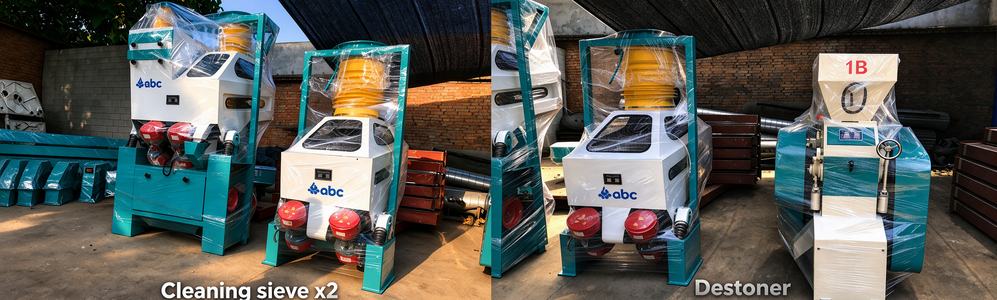
Wheat Cleaning Sieve and Destoner Machines for 10TPD Wheat Flour Mill Plant
Vertical wheat scourer - the stage that decides ash content
Surface dirt, mould spores and loosely attached bran cannot be removed by screening alone. The vertical wheat scourer scrubs the kernel surface, and this is the stage that most directly affects the ash reading of the finished flour. Bran that stays on the kernel through to the mill is bran that fragments and ends up in the flour stream.
Wheat is also tempered before milling, and the target window is narrow: wheat is typically conditioned to 15.5-17.5% moisture and rested for 36-48 h so that bran toughens and endosperm softens. Wheat milled outside that window is the most common reason a mill that tested well in the factory performs erratically after installation - which is why the conditioning parameters for the client's wheat are confirmed before shipment rather than left to the site.
Double roller mill - grinding in stages rather than all at once
Grinding on this set is done by a double roller mill, not a hammer crusher. The distinction decides three things a buyer will notice:
-
Bran stays in flakes. Roller milling shears and scrapes in stages, so bran leaves in larger pieces that are easier to separate from endosperm. A hammer crusher shatters grain and bran together and mixes bran dust evenly through the flour.
-
Less heat into the stock. Impact crushing generates more heat than staged roller milling, and heat damages starch and protein structure. Over-heated stock bakes differently.
-
A grade you can repeat. Staged milling lets you adjust each passage, so the same wheat can be held to the same specification batch after batch.
Pneumatic flour lifting - sealed transport, with an energy trade-off you should price
The pneumatic lifting unit moves ground stock between the mill and the sifting stage inside sealed pipework under negative pressure. Dust stays inside the system instead of in the workshop, and the stock can be routed vertically - useful when the available building is tall and narrow.
Pneumatic lifting costs more to run than mechanical lifting, and a buyer should know the ratio before signing. See the operating cost section below.
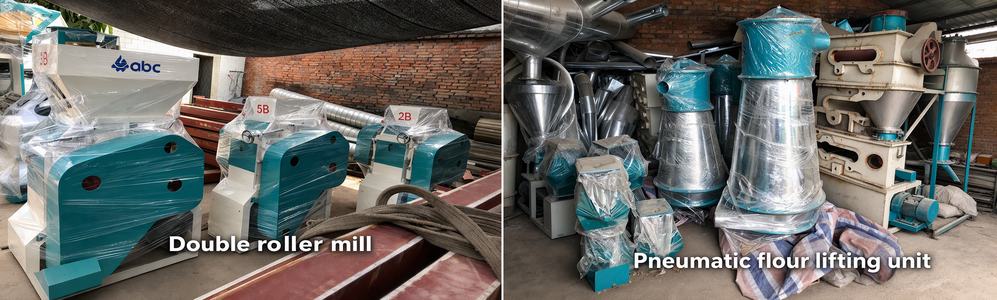
Double Roller Mill and Pneumatic Flour Lifting Unit of Wheat Flour Milling Machinery
What this means for buyers: ask for the process stage list, not the machine list. A quotation that names only mills is not a wheat flour milling plant - it is a set of mills that someone still has to integrate.Planning a wheat flour milling plant of your own? Send us your raw material and target flour grade, and our engineers will return a process flow and equipment list for your capacity - free of charge.
Factory testing and export packing before the container is loaded
Every set is trial-run on grain before it is packed. Buyers cannot inspect this stage from overseas, so it is documented.
What is checked during the trial run
-
Running the line on wheat, checking the drive, feed rate and roll gap settings.
-
Matching the cleaning section's throughput to the mill, so the front end feeds the back end instead of starving it.
-
Confirming the electrical configuration and motor ratings against the destination supply, so the installation team is not rewiring on arrival.
How the equipment is packed for a sea voyage
Roll surfaces are exposed, machined faces are easily bruised, and the container spends weeks at sea. Packing is therefore part of the engineering.
-
Roll surfaces and machined faces are protected before each unit is wrapped.
-
Each unit is wrapped and braced so it cannot shift inside the container.
-
Units are loaded in reverse order of unloading, so the first wheat flour mill machine out of the container is the first one the installation team needs.
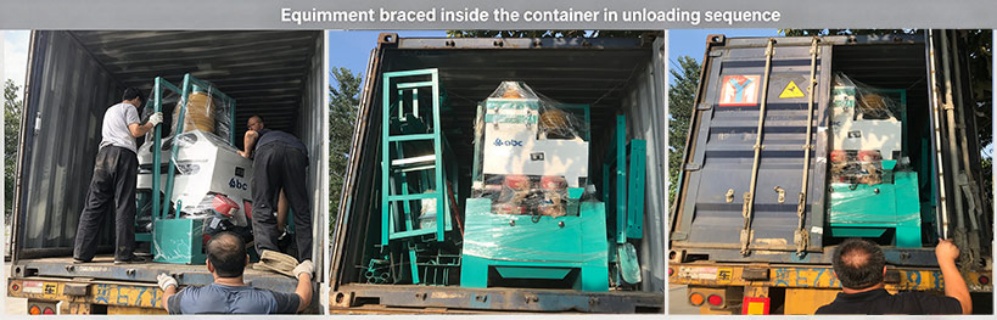
Loading Wheat Flour Processing Equipment Into Container for Australia Project Delivery
What this means for buyers: ask for the packing photos before the container sails. If a supplier cannot show how the machines were braced, you will be the one discovering the damage at the port.
How ABC Machinery supports your wheat flour milling plant
ABC Machinery supplies grain processing projects as complete sets rather than standalone machines, and stays with the project from process design through to operation.
|
Stage |
What we provide |
|---|---|
|
Pre-sales |
Raw material testing, process design, equipment list confirmation, workshop layout |
|
Manufacturing |
In-house production of core machines; key purchased components from established brands |
|
Factory trial run |
Running the set on your raw material before packing; test record shared with the client |
|
Export packing |
Protection, wrapping, bracing and container loading; packing photos before departure |
|
Installation & commissioning |
Engineers dispatched for on-site installation guidance, commissioning and operator training |
|
After-sales |
Wearing parts, remote technical support, overseas engineer dispatch |
If you are comparing suppliers for a wheat flour milling plant, the useful first step is a raw material test and a process flow for your own wheat - not a price list. Tell us your raw material, your target flour grade and the output you need, and we will send back the process stages, the equipment list for that capacity and the installed power of the conveying system.Free of charge and with no obligation - and if the numbers say your wheat suits a different configuration than the one you had in mind, we will tell you that as well.

Projects