 Build Your Future!
Rwanda's maize harvest reached 488,622 tonnes in 2026 Season A alone. The government's NST2 strategy (2024–2029) explicitly targets agro-processing expansion. Getting the equipment configuration right is what separates mills that capture these channels from those that fail compliance and sit idle.This guide breaks down Rwanda's raw-material conditions, the equipment tiers that match them, and the specification parameters that separate profitable maize flour mills from idle ones.
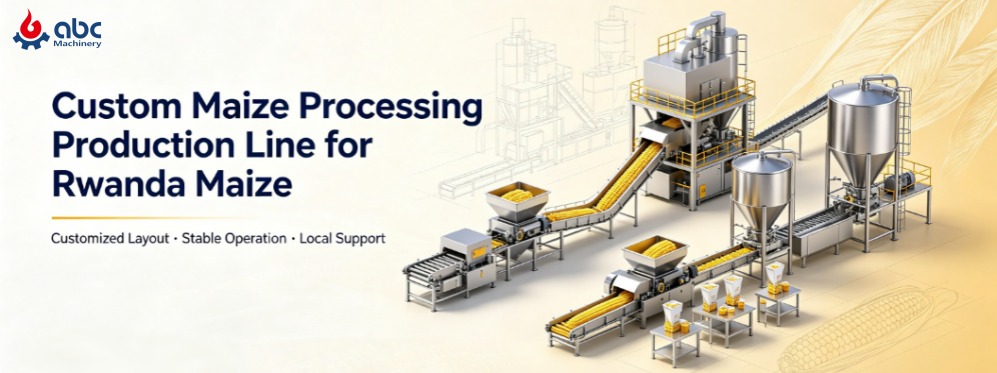
Rwanda Maize Raw Material Characteristics
Raw material conditions are the primary driver of equipment selection for any maize processing plant in Rwanda. Local maize differs substantially from standardised grain, and generic equipment consistently fails to adapt — this mismatch is the leading cause of failed greenfield milling projects in the region. Rwanda's maize output reached 553,953 tonnes in 2023 and is planned to grow to 874,337 tonnes by 2028/29 (NISR) — the processing capacity gap represents the single largest structural opportunity in Rwanda's grain industry.
-
High Moisture, Strong Seasonality Harvest moisture typically runs 15–25%; rainy-season harvests regularly exceed 25%. The safe milling baseline is 13.5–14.5% (Rwanda MINICOM official pricing document, 2024). Open-air sun drying cannot deliver consistent moisture control.
-
High Impurity and Mould Levels, Difficult Toxin Control Smallholder open-air harvest and storage results in elevated impurity and mouldy-kernel ratios. Aflatoxin levels frequently exceed the 10 µg/kg procurement threshold. WFP Rwanda's raw-material rejection rate stood at approximately 10–15% in 2022; after the roll-out of professional drying infrastructure, it fell below 3% by 2024.
-
Above-Baseline Moisture at Milling, Degermination Parameters Fail When maize enters the mill without reaching the moisture baseline, bran-germ adhesion remains strong and degermination efficiency drops sharply. Extraction rate losses of 3–6 percentage points compress per-tonne margins directly. → Applying generic domestic parameters results in incomplete bran-germ separation, reduced extraction, and coarse flour quality.
-
Concentrated Harvest, Storage Dependency Season A contributes approximately 80% of annual output (FAO GIEWS). Hermetic storage technology can cut post-harvest losses from 18% to 4% (FAO). A mill equipped only for grinding operates effectively for just 3–4 months per year, leaving equipment idle for over 60% of the calendar.
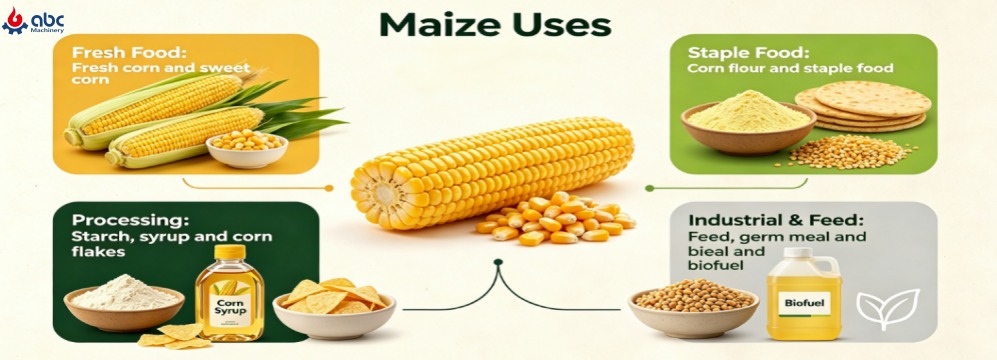
Infographic of Maize Uses: Food, Starch, Feed and Biofuel
These four characteristics make generic equipment unsuitable. A compliant, profitable maize processing line for Rwanda requires customised cleaning, drying, and milling configurations matched to local conditions. ABC Machinery can produce a precise corn flour equipment list and payback projection based on your site, budget, and capacity targets.Contact us to get free and professional answers immediately.

Rwanda Maize Processing Plant — Tiered Equipment Configuration
Rwanda's maize end-use is clearly segmented: approximately 60% is milled into flour, 37% goes to feed, and 3% to brewing (ResearchGate). The flour market is forecast to grow at a CAGR of 13.91–14.76% from 2025 to 2029 (6Wresearch, August 2025), with urbanisation at just 18.4% — consumption-upgrade headroom remains substantial. Your investment budget, site conditions, and capacity target determine which tier of maize processing equipment is the right fit.
Tier 1 — Asset-Light Entry: Drying, Storage & Pre-Processing Line
-
Equipment set: grain cleaning screen, destoner, grading equipment, mobile/fixed dryer, intelligent grain silo.
-
Key parameter: multi-stage cleaning raises impurity-removal rate from approximately 95% (single stage) to 97–98%, improving finished-flour consistency by 10–15% (ABC Machinery technical data).
-
Positioning: suited to investors entering the raw-material supply chain first — producing compliant, certified grain for direct supply to local mills, with no retail sales exposure and stable cash flow. This is the lowest-risk market entry route in East Africa.
Tier 2 — Core Investment: 10–50 t/day Standardised Maize Flour Production Line
This is the dominant configuration for commercial mill construction in Rwanda today. The complete maize production process covers the full flow from cleaning to packaging: pre-cleaning → constant-temperature drying → degermination & bran separation → multi-pass grinding → precision sifting → automatic packing. Every process parameter is calibrated against local raw-material conditions, not copied from generic factory defaults.
-
Key parameters (10–50 t/day scale):
-
Energy consumption: 15–25 kWh/tonne (decreasing with scale).
-
Reference investment range: USD 50,000–400,000 (small-scale USD 50k–120k; mid-scale USD 150k–400k).
-
Automatic packing reduces labour cost by approximately 20%.
-
Product range: refined maize flour, packaged commercial flour, Vitamin A fortified flour (EAS 768 compliant), maize germ, maize bran feed ingredient.
-
Sales channels: urban supermarkets, government school nutrition programmes, WFP-compliant procurement, export to neighbouring East African markets. Rwanda's maize wholesale price rose 38.9% year-on-year from 2024 to 2025 — the highest increase among four East African countries (IFPRI, August 2025) — widening the value-add margin for local processing.
The core of this solution is not equipment specification alone but the completeness of the maize production line and the precision of parameter calibration. ABC Machinery provides end-to-end technical support from site survey through to commissioning.
Tier 3 — Value-Add Add-On: Feed-Dedicated Processing Equipment
Bran, germ, and other by-products generated during milling have a ready market in Rwanda's feed sector. Poultry numbers in the region grow at approximately 9% per year; broiler demand peaks at a weekly shortfall of around 300,000 birds (The New Times Rwanda). Adding dedicated crushing and mixing equipment converts what would otherwise be waste into on-site revenue — low incremental investment, fast payback, and a direct uplift to overall project ROI.
Investment cost varies substantially across all three tiers. ABC Machinery can issue a precise equipment list and payback projection based on your site, budget, and capacity targets.
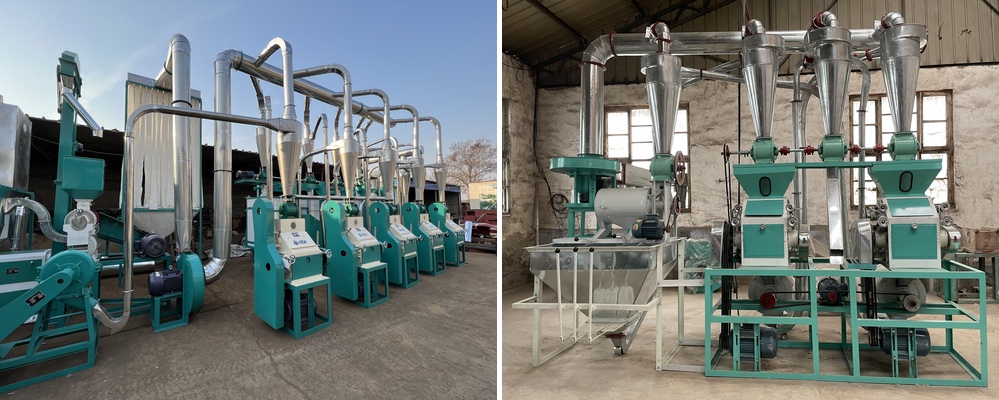
Complete Maize Flour Milling Production Line for Sale
From Cleaning to Packing: How to Configure a Maize Flour Line
Corn mill manufacturing Equipment selection is not about buying machines — it is about buying process completeness. The table below is a benchmarking checklist. Take any supplier quotation and cross-check it against the right-hand column line by line; wherever it falls short is a production risk waiting to materialise. Super-white maize flour extraction rates in East Africa range from 73% to 92% — a spread driven entirely by corn mill making equipment configuration and parameter calibration that maps directly to per-tonne profit margin.
|
Process Stage |
Core Equipment |
Parameters to Request in Every Quotation |
|---|---|---|
|
Pre-cleaning |
Vibrating screen / Pre-cleaner |
Screen dimensions, throughput capacity (t/h), impurity-removal rate |
|
Destoning |
Gravity destoner |
Air volume and screen amplitude, stone-removal efficiency |
|
Magnetic separation |
Permanent-magnet drum / Magnetic separator |
Magnetic flux density (Gauss), ferromagnetic impurity removal rate |
|
Moisture conditioning |
Tempering bin |
Target milling-moisture range, tempering duration |
|
Degermination |
Degermer (horizontal / vertical) |
Degermination rate, germ integrity, broken-kernel rate |
|
Grinding |
Roller mill |
Roll diameter (mm), roll surface pattern, fast/slow roll speed ratio |
|
Sifting & extraction |
Plansifter |
Number of sieve frames, mesh configuration, flour-extraction distribution |
|
Pneumatic dust collection |
Pulse-jet dust collector / Air network |
Airflow capacity (m³/h), emission concentration |
|
Weighing & packing |
Quantitative packing machine |
Bag weight options (10 / 25 / 50 kg), weighing accuracy |
When comparing Rwanda maize mill quotations, evaluate the parameters in the right column — not the model names. ABC Machinery fills in this table line by line for your target daily throughput and delivers it with every quotation, so every offer you receive can be compared against the same set of criteria.

Generic Equipment vs ABC Machinery Rwanda-Configured Equipment
The most common procurement mistake: sourcing generic domestic equipment for an African greenfield plant. It appears cost-effective at purchase; it proves unable to produce commercially once operational.
| Criteria | Generic Standard Equipment | ABC Machinery Rwanda-Configured Equipment |
|---|---|---|
| Toxin control | No mouldy-kernel removal; finished product frequently exceeds the 10 µg/kg aflatoxin threshold | Multi-stage screening + constant-temperature humidity-controlled drying; designed to EAS 44:2019 standard |
| Power compatibility | Factory-configured for domestic standards; frequent voltage fluctuations cause shutdowns | Matched to Rwanda 230V/50Hz; tolerates ±10% voltage variation |
| Extraction rate | Incomplete degermination under generic parameters; extraction rate 3–6 percentage points below optimum | Calibrated to local raw-material conditions; extraction rate 73–92% |
| Product range | Single product category; cannot switch between refined flour, fortified flour, and feed by-products | Supports 4-category product switching on a single line, covering all local revenue channels |
| Landing cost | No duty-free import support; spare parts difficult to source locally | Assists with Rwanda duty-free agricultural machinery import (applicable to approved investments) |
| Project support | Delivery only | Plant layout, installation, commissioning, operator training, and long-term after-sales — all in one engagement |
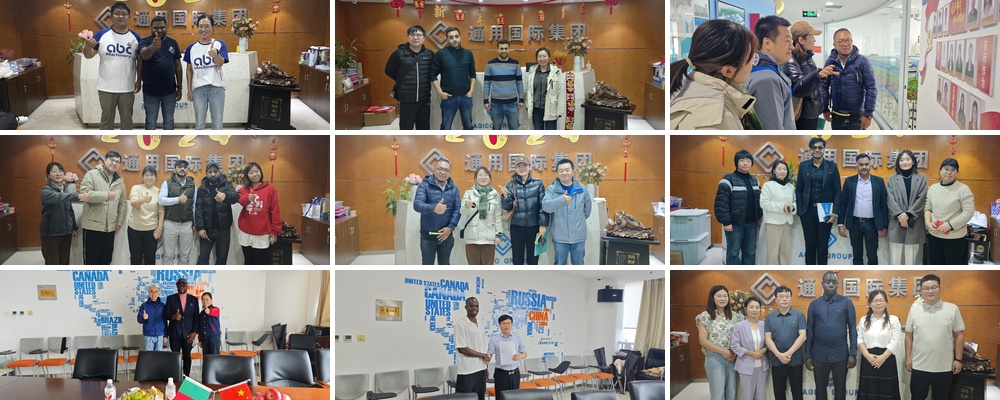
Global Flour Milling Machine Investors Visiting ABC Machinery
Every greenfield project in Africa has a unique combination of site, power supply, raw material, and capacity requirements. No standardised template fits all scenarios.Contact the ABC Machinery engineering team for a free Rwanda-specific capacity plan and budget quotation.

Projects