 Build Your Future!
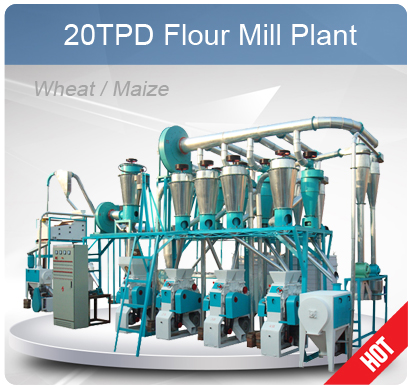
Ecuador is one of the great bread markets of Latin America and one of its smallest wheat growers. ABC Machinery has completed manufacture, factory verification and export packing of a 20 t/day wheat flour milling plant for a buyer in Ecuador.The wheat flour milling line was built in two sections: cleaning, and milling plus bagging. The flour mill machine buyer farms and trades grain, and the mill is the step that turns his own crop and his traded grain into flour.
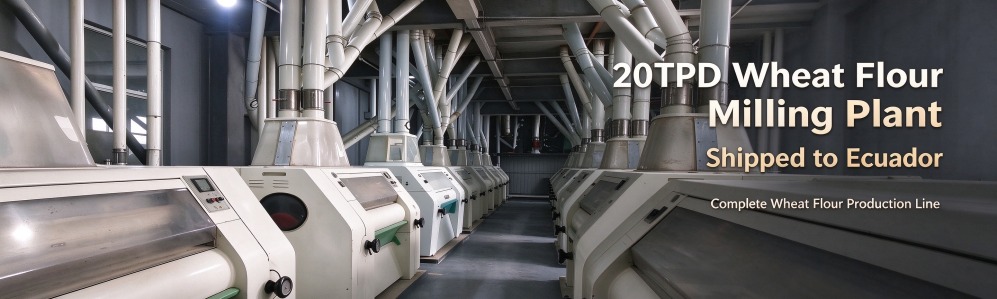
Project Background: A Bread Market Dependent on Imported Wheat
Ecuador has a large, habitual bread demand with high price sensitivity, supplied by wheat that is almost entirely imported and milled by a handful of large industrial millers. Capacity between those two scales is limited, and that is the segment a 20 t/day wheat flour milling line serves.
|
Parameter Index |
Details of the 20TPD Ecuador Project |
Industrial Competitive Advantages |
|---|---|---|
|
Daily capacity |
20 t of wheat intake per 24 hours, about 833 kg/h; 2.5 t/h on a single 8-hour shift |
Occupies the capacity band between village grinding and industrial mills, where little capacity exists |
|
Raw material |
Wheat, farm-delivered and traded grain |
Cleaning train sized for farm-delivered grain carrying field soil, rather than for pre-cleaned wheat |
|
Cleaning train |
Two sieves, two scourers, one destoner, one wheat washer |
Five separate removal mechanisms, so no single stage performs two functions |
|
Milling flow |
4 break 1 reduction |
Short flow: fewer passages to keep on grade, at the cost of some straight-grade extraction |
|
Finished product |
Wheat flour, straight grade |
Flour spec set at the sifting stage by screen aperture, not by the mill setting alone |
|
Bagging |
25 kg flour bagging machine |
Serves smaller bakery and retail buyers for whom a 50 kg trade sack is unsuitable |
|
Conveying |
Pneumatic conveying in stainless, separated in cyclones |
Flexible routing between stages, with no open transfer points to leak dust |
|
Installed power |
41.3 kW, 380 V / 50 Hz |
The published specification for ABC's 20 t/day wheat plant; about 50 kWh per tonne of wheat intake at rated capacity |
|
Workshop footprint |
16.5 x 5 x 4 m (L x W x H), about 82 square metres |
Single-storey building, roughly 4 square metres of floor per tonne of daily capacity |
|
Break rolls |
Fluted, differential about 2.5:1 |
Shear rather than crush, so bran stays intact and the endosperm fractures |
|
Reduction roll |
Smooth, one reduction passage |
Smooth rolls avoid introducing shear into endosperm that has already been cleaned |
|
Dust control |
Removal efficiency not less than 99.5% |
ABC's published figure for the dust removal system on this class of line |
|
Buyer's stated use |
Farmer and grain trader, milling his own and traded grain |
Converts a grain trading business into a flour business using the same raw material |
If you are weighing a 20 t/day wheat mill for your own grain, send us your wheat and the flour grade you intend to sell. We will come back with a process design, an equipment list and a workshop layout - free of charge and with no obligation.

How the 20TPD Wheat Flour Milling Line Is Configured
The engineering argument in this wheat flour milling line is not about tonnage. It is about how much dirt the wheat flour milling machine buyer's own grain brings in, and how much reduction the flour grade requires - and both answers come from Ecuador, not from a catalogue.
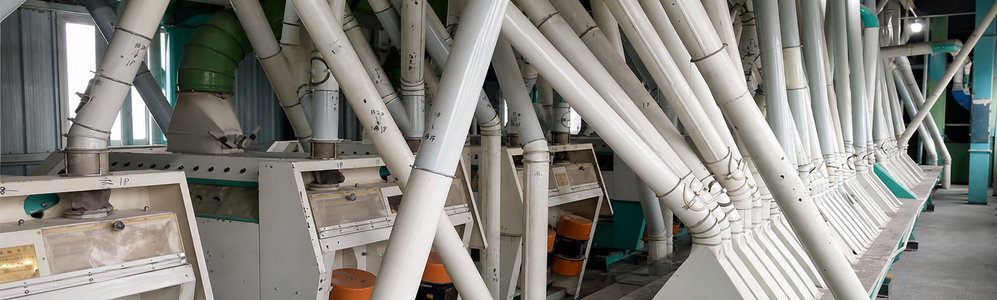
Machines and stainless spouting in the assembly hall, with the roll adjustment handwheel on the mill in view
Cleaning: Two Sieves and Two Scourers in Series
The cleaning train is deliberately redundant, and the reason lies in the raw material.
-
Two sieves rather than one, because farm-delivered wheat carries both large trash and small screenings, and separating those on one screen forces a compromise aperture that does neither job well;
-
Two scourers, because surface-borne dirt on traded grain is heavier than on grain that has been through a commercial intake system;
-
The sequence removes material by size first and by surface abrasion second, so later stages see grain rather than grain plus dust.
For a wheat flour milling machine buyer who is also a grain trader, this is the section that decides whether bought-in wheat and his own wheat can run through the same mill without changing the flour.
Destoning and Wheat Washing: Benefit and Cost
The washing machine is the least common item of wheat flour milling equipment in this configuration, and the reason for its inclusion warrants explanation.
What washing adds:
-
Removal that abrasion cannot reach. The grain arrives from farms and local trading, where soil, stones and surface contamination are normal. Washing removes what abrasion leaves behind, and it takes out stones by flotation as well as by density;
-
A start on tempering. Wheat has to be tempered before milling so that the bran toughens and the endosperm softens, and tempering normally runs from 6 to 24 hours depending on the wheat and its incoming moisture. Washing begins that process while it cleans.
What washing costs - a moisture budget rather than a matter of opinion:
-
Water has to be absorbed, not just added. Wheat stores safely at 12 to 13% moisture and generally has to be dried above about 16%. The water a washer adds must be absorbed within the tempering window instead of pushed past that ceiling;
-
Time and handling. Washed grain needs drain and rest time before it can be milled, the water has to go somewhere, and a wet grain stream introduces handling and hygiene requirements that a dry cleaning train does not carry;
-
The wetter the incoming grain, the smaller the share of the tempering window left to washing.
When washing is justified:
-
Farm-delivered grain carrying field soil - washing earns its place;
-
Grain pre-cleaned at a commercial intake - a third scourer and a second aspiration point normally achieve the same result with less water and shorter dwell time.
A wheat flour milling machine supplier proposing a cleaning train should be able to state which configuration is proposed and on what basis.
Roller Milling: the 4 Break 1 Reduction Flow and Its Trade-offs
The milling section is four break passages and one reduction passage. That is a short flow by industrial standards, and it is a deliberate trade.
-
Four break passages. They open the kernel progressively and scalp off bran, which is what a break system is for. Break rolls are fluted and run at a differential of about 2.5:1 between the fast and the slow roll, producing a shearing action rather than simple crushing. Commercial practice generally uses four to five break passages, so this flow sits at the compact end of the normal range;
-
One reduction passage. It reduces the middlings the breaks produce. Reduction rolls are smooth and run a lower differential - around 1.5:1 - so the two passage types differ by roughly two thirds in speed ratio, which is what separates a shearing pass from a reducing pass. Industrial mills run six to eight reduction passages, because each pass recovers flour from progressively finer middlings;
-
With one reduction passage, tail-end material that a long flow would keep grinding leaves as a coarser stream or as by-product. Straight-grade extraction is therefore lower than a long flow on the same wheat: simplicity and capital are bought with a few percentage points of extraction;
-
A mill that a small team can hold on grade. Fewer passages means fewer roll gaps to keep in adjustment and fewer places for the flow to drift.
Why the adjustment scale matters more on this line than on a large one. Every break and reduction passage has to be re-set for a different wheat, and the operator's ability to return to a known setting is what makes a short flow repeatable. The adjustment arrangement and the setting record are more informative than the roll diameter alone.
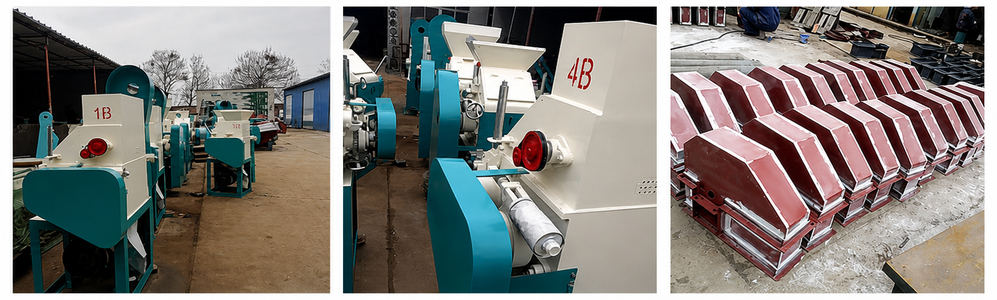
The break passages are labelled on the machines - 1B through 4B - and the fluted break rolls are shown laid out separately
Sifting and Bagging in 25 kg Bags
Sifting is the stage at which the flour grade is set. The milling section produces a spread of particle sizes, and the sifter decides which of them becomes saleable flour, which returns to the mill, and which leaves as bran or as a coarser stream.
Bagging on this wheat flour milling line fills 25 kg bags - half the mass of the 50 kg trade sack. That is a deliberate decision about the segment the mill serves:
-
Ecuadorian flour is traded by the 50 kg sack, and a line bagging at 50 kg competes directly with the industrial millers on their own unit;
-
At 25 kg the mill reaches the smaller bakery and the retail buyer, for whom a 50 kg sack exceeds the volume a small customer wishes to purchase at one time;
-
At 20 t/day the packing station fills roughly 800 bags a shift.
The Flour Specification, in Measured Terms
A grade described only as "straight grade" cannot be tested. The reference specification for ABC's wheat flour plants is stated in Mixolab terms, which a buyer's own laboratory or bakery can reproduce:
|
Parameter |
Reference value, wheat flour |
|---|---|
|
Water absorption |
61.93 +/- 0.1% |
|
Dough development time |
6.21 +/- 0.09 min |
|
Development (C1) |
1.12 +/- 0.03 Nm |
|
Stability |
8.58 +/- 0.41 min |
|
Mechanical weakening |
0.08 +/- 0.01 Nm |
These are reference values for the flour rather than a guarantee for any given wheat: absorption, development time and stability all move with the variety, the growing season and the extraction rate.
Extraction rate is the flour yield expressed as a percentage of wheat intake. 100 kg of wheat yielding 75 kg of flour is a 75% extraction, and commercial straight-grade extraction sits in that range. A short flow recovers less than a long one; on typical milling wheat the gap sits in the order of a few percentage points of straight-grade extraction. That figure is a planning range rather than a result, because it has to be measured on the wheat flour milling machine buyer's own wheat before it means anything.
Ash content is how millers actually grade a stream. Published analyses of commercial mill streams record break flour at 0.48 to 0.95% ash and reduction flour at 0.39 to 1.59% - which is why the sifting circuit, and not the mill setting alone, decides what goes into the bag.
Pneumatic Conveying Between Stages
Material is lifted between stages by air, through stainless pipework, and separated from the air in cyclones. The system is built this way for two reasons that matter at this size:
-
Routing. Pneumatic conveying can turn corners and rise vertically, so the line fits a workshop footprint that a purely mechanical layout would struggle to serve;
-
Closed transfers. Grain, middlings and flour never travel on an open belt, so dust release and cross-contamination between streams are controlled by the pipework itself rather than by housekeeping. ABC specifies dust removal at an efficiency of not less than 99.5% on this class of wheat flour milling line.
The wheat flour milling plant cost is electrical, and it is measurable:
-
Conveying accounts for roughly 30% of a mill's electrical load in published milling energy studies;
-
In a like-for-like comparison at 10 t/h with a vertical lift of 20 m, pneumatic lifting drew about six times the power of a mechanical alternative;
-
That penalty can be worked down. Fan power follows the cube of airflow, so a 20% reduction in airflow - achieved by sealing leaks and sizing ducts correctly - cuts fan power by about half.
At 20 t/day wheat flour milling line the routing flexibility justifies the power cost. The buyer should still request installed power rather than a motor schedule, together with the air-to-material ratio at the wheat flour milling plant design point.
Stainless pneumatic spouting in the assembled line, and the same spouting runs before they are packed
Factory Verification: What the Pre-Shipment Photographs Document
The verification photographs from this project work as a checklist, because they show what was inspected rather than what was promised.
-
The roll-gap adjustment dial, photographed close enough to read the graduations. That single image is the evidence that the mill is adjustable, and by how much: it is the difference between a wheat flour milling machine that can follow a change of wheat and one that cannot;
-
The mill body, guards and castings, photographed before crating, so that frame stiffness and the fit of the doors and covers can be seen rather than assumed;
-
The cleaning and conveying sections in the same hall, with the stainless spouting in place. This is the purpose of a pre-shipment inspection: to confirm that components designed as one system were assembled as one system before the container was closed.
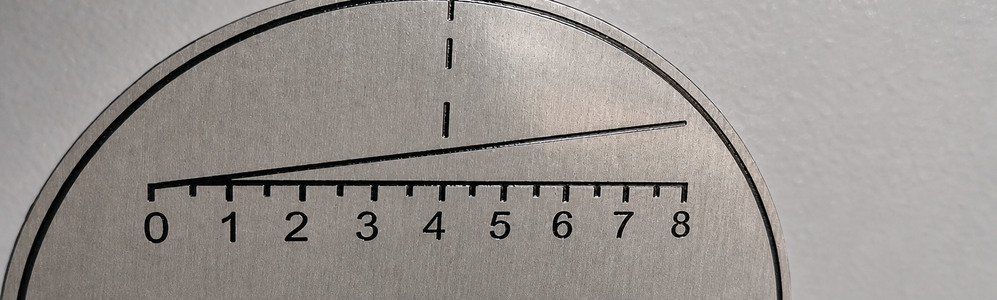
The roll gap adjustment scale - the graduations an operator uses to return each break and reduction passage to a known setting
The Milling Hall, Seen Down Its Length
The long interior views are more informative than close-up wheat flour milling machine photographs. A view down the hall shows the runs of spouting, the position of the cyclone batteries, and the spacing between machine rows.Row spacing is the dimension that determines whether the wheat flour milling plant can be serviced: whether a fitter can reach a bearing, and whether a roll can be withdrawn without dismantling a neighbouring machine. A wheat flour milling machine supplier able to provide that photograph has documented the maintainability of the flour milling plant.
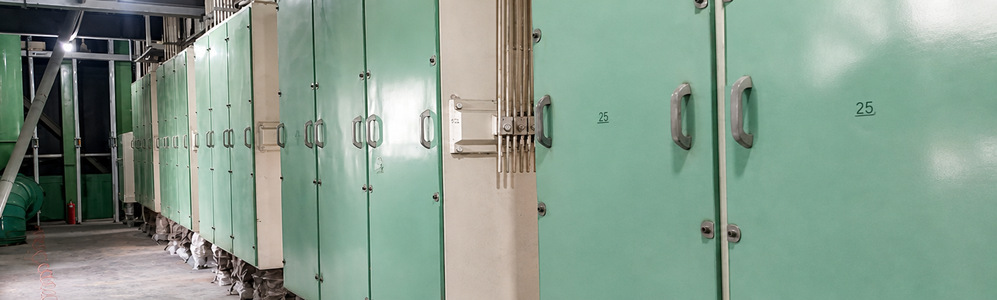
Looking down the milling hall: machine rows, the spacing between them, and the position of the cyclone batteries
Electrical, Protection and Documentation
A mill that ships to a farming business has to be handed over with the electrical documentation finished, not sketched on site. Before the container is closed, four items need to be recorded against the delivered configuration:
-
The starter and control arrangement;
-
The motor protection settings;
-
The earthing arrangement;
-
The interlock between the conveying fan and the mill feed.
The drawings and spare-parts list travel with the equipment.
Packing for a Long Sea Route
Ecuador is reached by sea across the Pacific, and the wheat flour milling equipment is transloaded at least once. Packing follows three rules:
-
Weight on structure. Heavy castings and mill frames are packed so that the load sits on the structure rather than on a cover;
-
Separation. Spouting and fabricated frames are packed apart from the machines they belong to, so that nothing is dented by the item next to it;
-
Unloading order. The loading plan follows the unloading sequence, so that items required first on site are unloaded first.
For a wheat flour milling machine buyer who already grows and trades grain, moving from selling wheat to selling flour is not a larger version of the same business. It means a different customer, a different unit of sale and a different set of quality expectations.ABC Machinery builds wheat and maize milling plants and supports grain processing projects across Africa, Asia and Latin America. Tell us your wheat, the flour grade you intend to sell and the capacity you need, and we will come back with a process design and an equipment list for your conditions.Free of charge and with no obligation - and if your wheat suits a different configuration than the one you had in mind, we will tell you that as well.
- How much wheat does a 20 t/day wheat flour milling plant use in a year?
- About 6,000 t if it runs roughly 300 days a year, which is the raw material going in, not flour coming out. The flour yield is lower than the intake weight because bran and a coarser stream leave as by-product, and the exact extraction depends on the wheat and the grade.
- Is a wheat washing machine necessary in a flour mill?
- It depends on where the grain comes from. Washing removes soil, stones and surface contamination that dry cleaning leaves behind, and it starts the tempering process. It also adds waste water, drain and rest time, and a wet handling consideration. Where the wheat arrives pre-cleaned, additional scouring and aspiration normally achieve the same result with less water.
- What does 4 break 1 reduction mean, and is it enough?
- It describes the milling flow: four break passages that open the kernel and scalp off bran, and one reduction passage that grinds the middlings. It is a short flow. It recovers less straight-grade flour than a long industrial flow, in exchange for fewer passages to maintain - a configuration suited to operation by a small team.
- Why bag in 25 kg if flour is traded by the 50 kg sack?
- Because it addresses a different buyer. The 50 kg sack is the trade unit the industrial millers already compete on. A 25 kg bag reaches smaller bakeries and retailers who would not buy or handle a full trade sack. At 20 t/day the packing station fills roughly 800 bags a shift.
- What should I ask to see before a flour mill ships?
- Ask for the mill assembled and run, photographs of the roll-gap adjustment arrangement with the settings recorded, the electrical drawings and protection settings, and the packing and loading plan. On a sea route with transloading, what was verified before crating is the only item that cannot be re-checked later.

Projects