 Build Your Future!
A maize mill does not make one product. It opens a tonne of grain into flour, grits, germ and bran, and every stream leaves the gate at its own price. Product mix, more than capacity, decides whether the plant earns a milling fee or a brand margin.This article defines those streams against the specifications our own plant proposals use, prices them in one African market where both ends of the chain are published, and explains why the global market-size figures used in most business plans cannot be compared without their scope. It belongs to the column A Look into the Maize Processing Market.
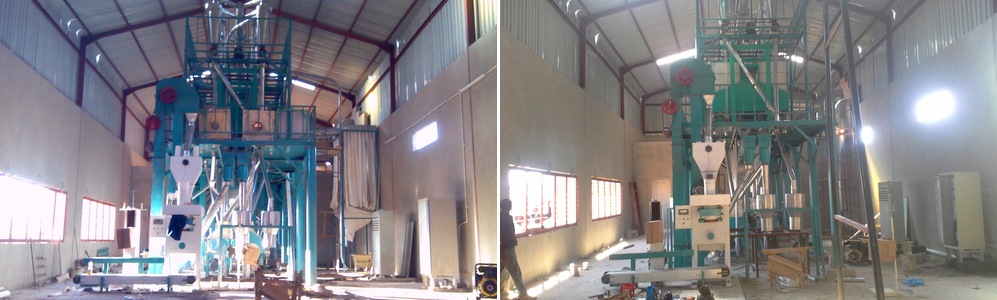
50 t/d Maize Line in Zambia
What Counts as a Dry-Milled Maize Product
Dry milling cleans the grain, removes germ and bran by mechanical action, then reduces the endosperm. There is no steeping, no sulphur dioxide and no starch separation. The line is a sequence of cleaners, a de-huller, a degerminator, roller mills, sifters and packers.That boundary separates two industries. Wet milling recovers starch, glucose syrup and gluten meal in plants that cost several times more per daily tonne. Dry milling sells food ingredients, and the choice between dry and semi-wet corn milling already fixes most of the product range before a single machine is ordered.
|
Product |
Specification |
Fat |
Main buyer |
Share of output |
|---|---|---|---|---|
|
Maize grits |
graded on 1# to 3# screens, 3–4 cuts |
— |
Brewers, snack extruders, cereal plants |
30–50% on a grits-first line |
|
Maize flour, coarse |
30–40 mesh |
≤2% |
Household staple, institutions |
75–80% on a flour-only line |
|
Maize flour, fine |
all through 60 mesh |
≤2% |
Bakeries, coatings, noodles |
70–75% on a flour-only line |
|
Germ |
whole, screened out before reduction |
30–40% oil |
Oil mills, feed mills |
7–9% |
|
Bran and fodder flour |
hull, tip cap, attached endosperm |
— |
Animal feed |
10–30% |
Shares come from plant proposals for 15 to 100 t/d lines. A grits-first configuration takes about forty points away from flour and returns them as grits plus a fodder stream.
Terminology: Chinese standards recognise two product classes only, GB/T 10463 for maize flour and GB/T 22496 for maize grits. Fineness is a grade inside the flour class, not a separate product name.
Where dry milling stops and wet milling begins
Wet milling is a chemical plant built around starch recovery, from steep tanks to disc separators and driers. A dry mill cannot be converted into a wet mill by adding machines, and a wet mill is not the answer for porridge flour.
Where the market buys maize as flour or grits, the dry route is the correct plant. The investment question then becomes product mix rather than process chemistry.
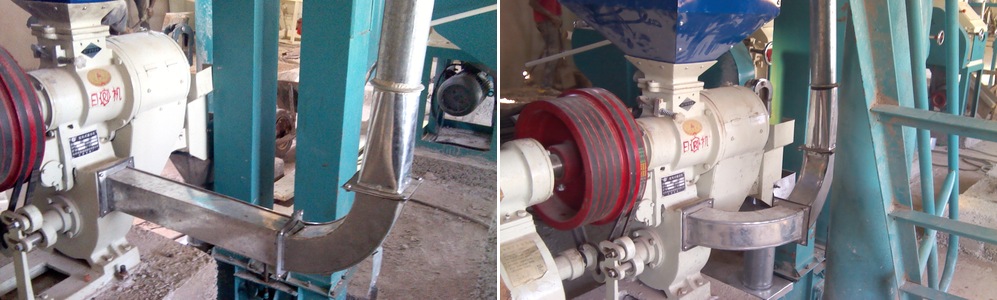
Roller Mill and Drive Section
One Tonne of Maize, Four Output Streams
On a flour-only line, one tonne of clean maize leaves as 700–800 kg of flour, 70–90 kg of germ and 100–300 kg of bran and fodder. The split is set by the line, not by the grain.
The germ is the difficult fraction. It carries 30–40% oil, and oil in flour oxidises within weeks. A mill that lets germ through gains a few points of yield on paper and loses shelf life in the market.
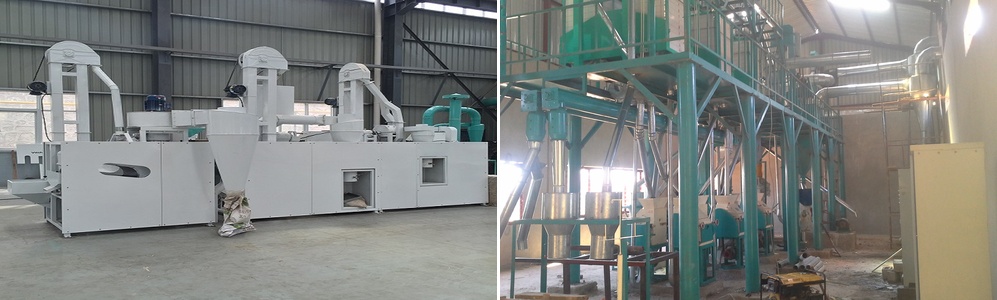
15 t/d Grits and Flour Unit
The germ decides the grade, not the by-product
Degermination has to be complete before the first reduction pass. Broken germ smears oil across the semolina and blinds sifter screens. Whole germ leaves as a clean stream that oil mills will buy at a price of its own.
The de-huller does the rough work with an abrasive roller that cuts and scours the hull away, loosening the bond between hull, germ and endosperm; a separate degerminator then lifts the germ out. Quality control on a corn milling plant starts at those two machines, long before the first flour test is run.
What a fineness grade costs in yield
Fineness is not free. Grinding finer, and holding the bran out harder to keep the specification, takes points off the yield. Our own proposals show the trade-off clearly.
|
Line type |
Target fineness |
Flour yield |
By-product stream |
|---|---|---|---|
|
Flour only, 15 t/d |
all through 60 mesh |
70–75% |
bran and fodder 25–30% |
|
Flour only, 20–50 t/d |
30–40 mesh |
75–80% |
germ plus bran and fodder 20–25% |
|
Flour only, 100 t/d |
all through 60 mesh |
70–75% |
bran and fodder 25–30% |
|
Flour and grits, 24 t/d |
3–4 grits cuts |
grits 45–50%, flour 25–30% |
germ and fodder flour 20% |
|
Flour and grits, 30 t/d |
grits plus flour |
grits 30–40%, flour 30–40% |
germ, bran and fodder 20–25% |
The five points between a 30–40 mesh line and a 60 mesh line are the price of fineness: about 50 kg of every tonne moved from product to by-product.
A grits line changes the picture again. Flour drops to 25–40% while grits take 30–50%, and the coarse cut sells to a different buyer entirely.
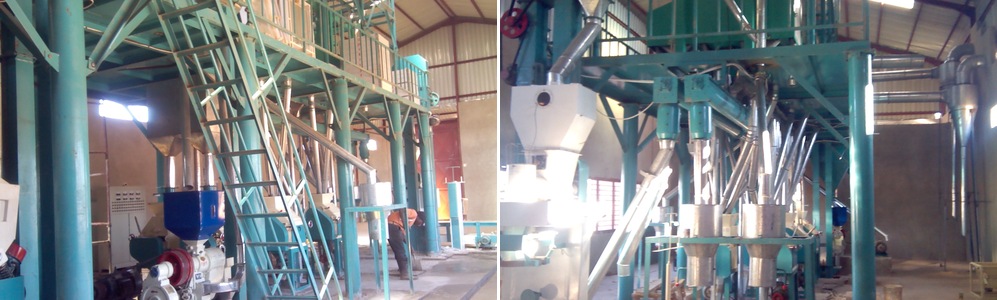
Spouts Separating Meal and Grits
The Price Ladder in a Real Market
Zambia publishes both ends of the chain. The Food Reserve Agency set the 2026 crop buying price at ZMW 347 per 50 kg bag, and the national statistics agency tracks retail mealie meal every month.
Setting the two side by side gives the spread a mill actually works with, from grain in the yard to a branded bag on a shelf.
|
Item |
Pack |
Price (ZMW) |
Per kg (ZMW) |
Index, grain = 100 |
|---|---|---|---|---|
|
Maize grain, FRA 2026 buying price |
50 kg |
347.00 |
6.94 |
100 |
|
Roller mealie meal, retail |
25 kg |
202.28 |
8.09 |
117 |
|
Breakfast mealie meal, retail |
25 kg |
252.13 |
10.09 |
145 |
FRA price announced on 24 July 2026; retail prices from the ZamStats monthly collection for July 2026. Retail prices include packaging, transport and tax, the grain price does not.
Why breakfast meal earns 45% more per kilo
The two retail products come from the same grain. Breakfast meal is milled finer and at lower yield, so more bran and germ leave the food stream. The 45% retail gap is what the market pays for that removal.
Set that against the five points of yield a finer grade costs, and the premium is worth chasing wherever the retail spread is real. The calculation only works when both products have a buyer inside the delivery radius.
A low-yield line also puts more bran and germ on the by-product side, while a high-yield line puts less. Neither is better until the local by-product prices are known.
Where the second and third streams pay
On a 50 t/d line, germ at 7–9% is 3.5–4.5 t/d and bran plus fodder at 10–15% is 5–7.5 t/d. Germ at 30–40% oil is feedstock for oil mills, while bran and fodder go straight to feed.
A mill that sells flour only is selling the endosperm and giving the rest away. For a new project, a 5 to 50 t/d maize flour production line is normally specified with a germ and bran outlet for exactly this reason.
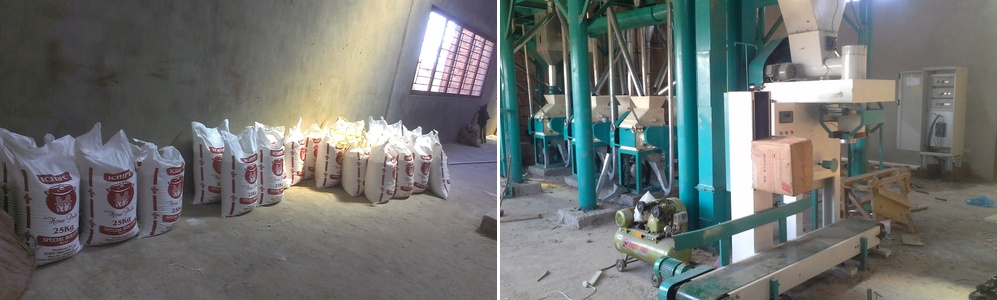
25 kg Bags and the Packing Area
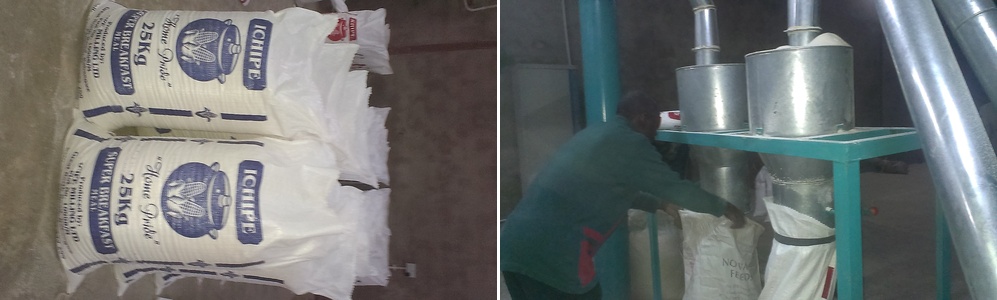
Printed Bags and Filling Spout
The Market-Size Numbers Do Not Agree
Business plans for maize projects usually open with a global market figure. For the same year, published figures differ by a factor of five, because each report draws the product boundary in a different place.
|
Source |
Scope |
Value |
Growth |
|---|---|---|---|
|
WiseGuyReports |
Dry milled corn products |
USD 16.1 bn (2025) |
3.4% CAGR to 2035 |
|
SNS Insider |
Dry milled corn |
USD 89.72 bn (2025) |
6.34% CAGR |
|
Future Market Insights |
Corn flour |
USD 20.6 bn (2025) |
6.3% to 2026 |
|
Cognitive Market Research |
Maize flour |
USD 33.5 bn (2024) |
5.0% CAGR to 2031 |
Why the spread is that wide
Some scopes count the grain entering the mill, others count ingredient value at the factory gate. Some include starch and glucose, some count branded retail. A figure without its scope is decoration, and a business plan built on one is a guess with a decimal point.
What to use instead of a global number
The workable number is local: price multiplied by volume. A 50 t/d line at 70–75% yield produces 35–37.5 t of flour a day. At ZMW 10.09 per kg that is ZMW 353,000 to 378,000 a day of output at retail parity, before distribution and trade margin.
That figure can be tested against the mills inside the delivery radius, which is what actually sets the price. Country studies such as maize milling in Uganda and maize flour plants in Kenya show how far the local answer moves.
Supply moves margins more than any CAGR
South Africa's 2026 maize crop is forecast at 17.1 Mt, the third-largest on record. Zambia harvested 4.94 Mt in the same season, up 27.8% on a drought year.
Swings of that size reset grain cost twice a year. For a mill buying spot grain they matter more than a five-year average growth rate, and they are the reason plant efficiency is measured in cost per tonne rather than in output alone.

Matching Product Mix to a Capacity Band
Capacity decides how many streams can be separated economically, and it brings its own power and floor-space bill. Below a threshold, the second sifter and the second product bin cost more than the grits premium returns.
|
Capacity |
Power supply |
Workshop L×W×H |
Mix that works |
|---|---|---|---|
|
15 t/d |
about 70 kW |
20 × 6 × 4.5 m |
Flour only, 60 mesh, 1 x 20 ft container |
|
20–30 t/d |
65–72 kW |
16.5 × 6 × 4.5 m |
Flour only at 30–40 mesh, or grits plus flour |
|
50 t/d |
about 120 kW |
30 × 9 × 7.5 m |
Flour plus germ recovery, 2 x 40 ft containers |
|
100 t/d |
about 625 kW |
35 × 10 × 12 m |
Flour only, 60 mesh, silo and automation |
The expensive step is moving from one product to two. It adds sifting area, bins and conveying, and it changes operation: two products mean two quality targets running on one flow.
Above 50 t/d the constraint moves from sifting to packing and dispatch. An 80 t/d maize flour and grits plant in Uganda shows the layout that results when both streams have to be packed separately.
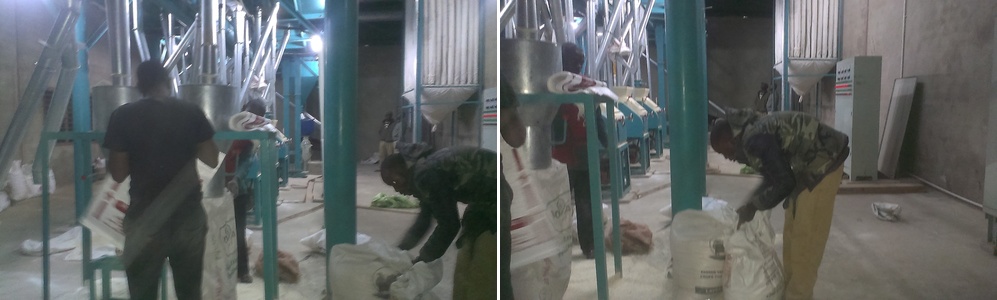
Bagging on the 50 t/d Line
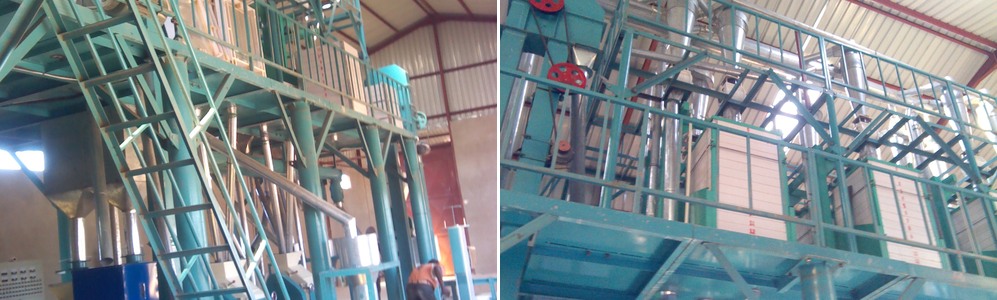
Sifting Floor and Stairway
- How much maize flour does one tonne of maize yield?
- On a flour-only line, 700–800 kg at 70–80% yield. The remainder leaves as germ, bran and fodder flour, plus moisture loss, and the germ stream is where a well-run mill recovers part of the difference.
- Is maize grits more profitable than maize flour?
- Grits carry a premium where brewers or snack extruders are within reach. Without that buyer the grits cut becomes rework, and a flour-only line is the safer specification. Grits projects are usually built beside a brewery for this reason.
- What is the difference between maize meal and maize flour?
- Fineness and yield. A 30–40 mesh cut is sold as coarse flour for porridge and institutions; 60 mesh, passed in full, is bakery and coating grade. In Chinese standards both sit under GB/T 10463 as different fineness grades.
- What does a maize milling plant cost?
- Cost follows capacity, degermination and packing, and the power bill scales faster than the tonnage. A 30 t/d line draws about 65 kW, a 50 t/d line about 120 kW and a 100 t/d line about 625 kW, so the electrical installation grows faster than the tonnage.
- Which capacity should a first plant take?
- The band that matches demand inside the delivery radius, not the largest unit the budget allows. A 5 t/d maize unit and a 10 t/d flour line are both entry points; the difference is how fast the market absorbs the output.



Projects