 Build Your Future!
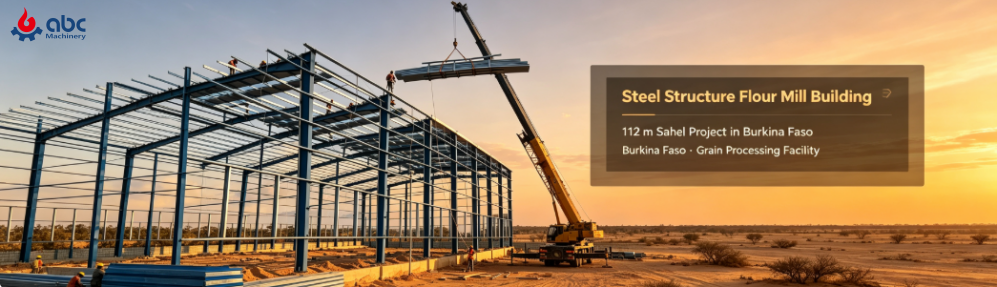
West African food processing has outgrown the single-line shed, and the wheat flour mill plant of the past — one line in one building — no longer matches how regional investors plan capacity. This article examines the wheat flour mill plant ABC Machinery delivered in Ouagadougou: a 112 m steel structure housing a 100 TPD wheat flour production line, a pasta line and warehousing, engineered for the Sahel's climate, supply chain and operating economics. Buyers planning integrated grain-processing capacity will find the same decision framework this project used.
Project Data: A Wheat Flour Mill Plant in Two Sized Bays
This wheat flour mill plant project rejected the conventional approach of one uniform building height. Different stages of the wheat flour milling process make different demands on equipment height, continuous floor space and heat rejection; a single eave height would have forced the wheat flour milling machines and the warehousing equipment to share one spatial scale, wasting structure. The 112 m building was therefore split into two functional bays, matching the space demand of each wheat flour production line stage to the construction budget:
| Parameter | Detail |
|---|---|
| Total building size | 112 m long × 25 m wide |
| High-clearance bay | 30 m long, 15 m eave height |
| Standard operational bay | 82 m long, 10 m eave height |
| Functions housed | 100 TPD wheat flour production line, pasta line, warehouse |
| Primary frame | High-strength H-beam columns and girders |
| Secondary structure | C-section purlins, tie rods and diagonal bracing |
| Envelope | Insulated color steel roof, 50 mm composite wall panels, polycarbonate skylight strips |
| Building services | Industrial roller shutters, forced ventilation, roof drainage gutters |
| On-site installation program | Three months, steel erection through envelope completion |
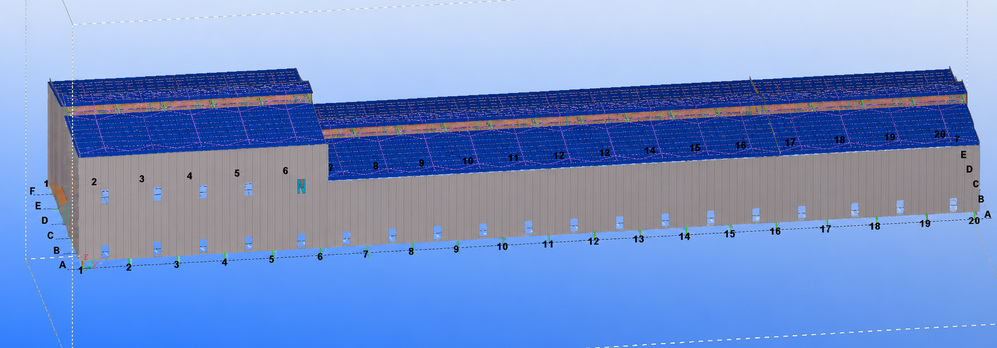
3D BIM Model for Flour Mill Steel Building
The design logic starts from the wheat flour milling process itself. A 100 TPD wheat flour production line runs tall, continuous equipment with concentrated heat rejection, so the 30 m bay at 15 m clearance gives the wheat flour milling machine installation the headroom it needs for assembly, servicing and heat escape, while the 82 m bay at 10 m handles warehousing and auxiliary work at lower cost.Contact us to get free and professional answers immediately.

Steel vs Concrete: Five Factors That Decided This Plant
Steel was not a preference on this wheat flour mill plant project. It was the commercial optimum reached by assessing Burkina Faso's location, climate, supply chain, site conditions and full-lifecycle cost — five advantages that map closely onto the realities of Sahel and West African inland food plants.
1. Faster to Production, Past the Rainy-Season Risk
-
The concrete sequence is serial. Foundations, columns and beams are cast in order, followed by a standard 28-day curing period before wall and roof work can start. Under West African rain patterns and local labor productivity, the overall schedule of a wheat flour mill plant typically runs 10–14 months, inflating wheat flour mill plant cost through the curing period and the rainy-season risk.
-
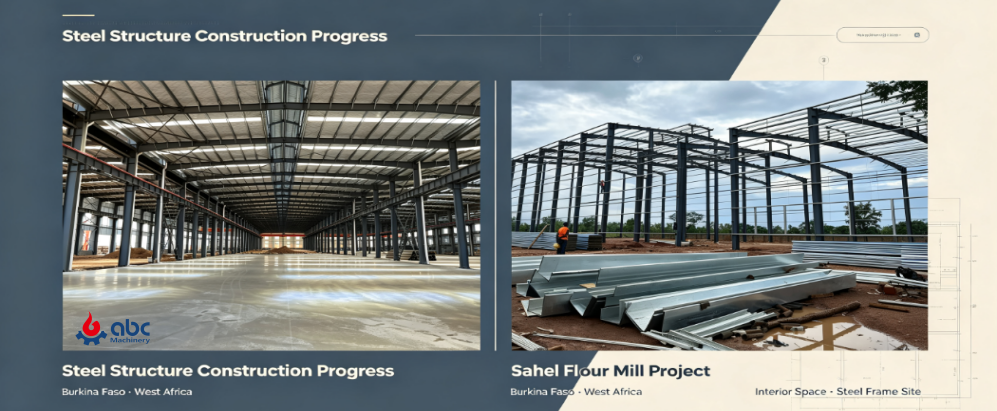
The steel sequence runs in parallel. The wheat flour milling machines and the structural steel members are prefabricated, pre-assembled and inspected at the overseas factory while foundations are prepared on site; erection is then a bolting operation with standardized members. On this project, the steel program ran three months from first erection to a closed envelope, sharply reducing the schedule risk embedded in wheat flour mill plant cost.
2. A "Breathing" Envelope for Heat and Dust
Thermal environment directly determines whether the wheat flour milling process runs reliably, so the envelope was treated as part of the process design. Ouagadougou's hot season peaks above 40 °C, and the dry-season harmattan wind carries dust for months on end:
-
Concrete stores heat. Its high thermal mass absorbs heat during the day and releases it slowly at night, leaving a milling hall uncomfortably warm around the clock.
-
Steel with an insulated skin sheds it. The insulated color steel roof cuts radiant gain and can hold the interior 3–5 °C below an uninsulated alternative, while forced ventilation exhausts the hot air that stratifies in the 15 m bay. The high clearance acts as a thermal buffer: heated air rises above the wheat flour milling machine zone and is removed before it radiates back down, keeping motors and pneumatic conveying systems stable and giving the wheat flour milling machines a lower-failure operating environment.
3. Flexible Wheat Flour Mill Plant Layout with Room to Grow
The wheat flour production line, the pasta line and warehousing have different height demands, and those demands change as the wheat flour milling process is upgraded over time. Steel delivers large, column-free spans, which is why the same roof can carry a 15 m bay and a 10 m bay side by side to serve different process stages. Later expansion — replacing sifters, adding packing lines, rearranging storage — moves internal partitions only. A concrete structure fixes the space: reconfiguration usually requires partial demolition, at a cost typically three to five times that of modifying steel — a difference often missing from wheat flour mill plant cost estimates.
4. Lifecycle Cost: What the Unit Price Hides
Assessing wheat flour mill plant cost by comparing per-square-meter prices misleads; the steel advantage shows across the full lifecycle:
-
Less foundation work. Steel weighs roughly one-third as much as an equivalent concrete frame, so column loads — and foundation sizes on the laterite soils typical of the region — come down correspondingly, cutting foundation cost by an estimated 40%. On African projects, foundations are the line item most likely to overrun the budget.
-
The envelope finishes itself. A 50 mm composite wall panel closes the building and delivers insulation, dust exclusion and a washable, food-grade interior surface in one operation — meeting the hygiene requirements of the wheat flour milling process directly — where a concrete wall needs block infill, plaster and paint.
5. A Supply Chain Built for a Landlocked Market
-
Burkina Faso is landlocked; every ton of construction material arrives by road from a West African port, and a week of site idleness carries real equipment and management costs — one of the most overlooked entries in wheat flour mill plant cost.
-
Steel moves the critical fabrication off-site: components are made, inspected and labeled before loading, and the standardized assembly sequence of the wheat flour milling machines keeps the technical barrier for local crews low.
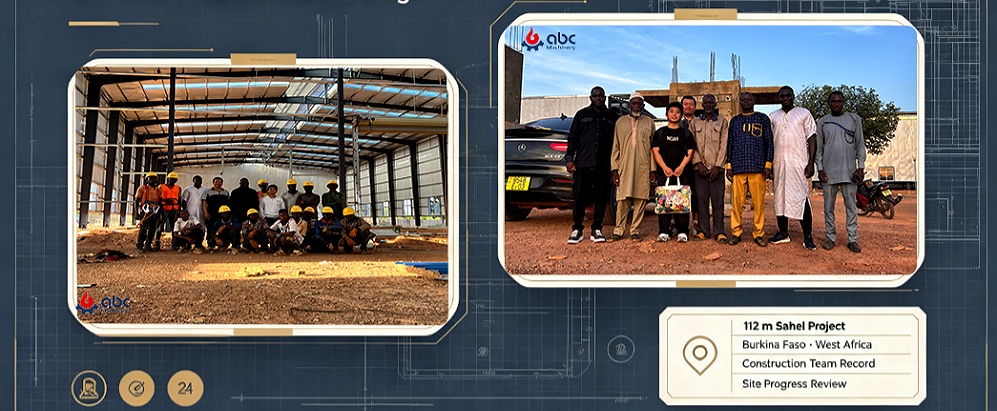
Construction Team of Sahel Grain Plant Project
ABC Machinery: Delivering the Whole Wheat Flour Mill Plant
ABC Machinery supplies West African projects as complete plant solutions rather than single machines. Where local supply chains are thin, the climate is extreme, site construction capacity is limited and schedule cost is high, one team coordinates the wheat flour milling process layout, the building structure, climate adaptation, wheat flour milling machine installation and commissioning to production under a single responsibility.

Overseas Flour Mill Machine Customers Visit AGICO Office
If you are planning a flour, pasta or integrated grain-processing project in West Africa, send your target capacity and site conditions to the ABC Machinery engineering team. The building and the process line are designed as one system, matched to your market and your site rather than copied from a template — keeping wheat flour mill plant cost under control from the drawing stage.

Projects