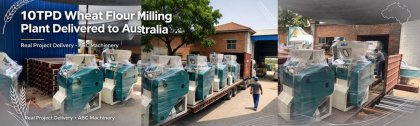
 Build Your Future!
Tanzania boasts an annual maize output of 500–600 million tons, yet the local grain processing rate remains below 30%, with nearly 40% of urban flour supply relying on imports. This article provides a complete and practical decision‑making guide for investors planning to deploy flour processing equipment in Tanzania. The core insight is clear: modular processing lines with verified technical parameters can control power consumption at 65–75 kWh per ton of flour and maintain a stable flour extraction rate above 85%.
Tanzania Flour Market and Product Overview
Flour is the staple food for Tanzanian residents, mainly divided into maize flour and wheat flour. With a population of over 65 million, Tanzania obtains more than 80% of daily dietary calories from maize, with a per capita annual maize consumption of approximately 100 kg. Significant differences in raw material sources and consumer specifications between urban and rural areas directly determine the equipment configuration of local flour processing plants.
Two Mainstream Flour Categories and Applications
-
As the country’s dominant staple, maize flour is primarily used to make Ugali, a traditional Tanzanian thick porridge.
-
The local maize processing market includes Sembe refined fine flour for urban supermarket sales and Dona coarse flour with high bran content for rural low‑end markets.
-
Wheat flour is the mainstream baking raw material in Tanzanian cities, widely used for bread, biscuits and Chapati flatbread.
-
Tanzania’s domestic annual wheat production is only 77,000 tons with a self‑sufficiency rate below 6%. Most wheat is imported and processed locally. Many mature processing enterprises rely on well‑equipped wheat flour mills in tanzania to complete flour production and market distribution.
Local Processing Industry Status
-
Over 95% of local maize flour is produced by small and simple rural milling workshops. These traditional facilities usually achieve only 65–72% flour extraction and have weak impurity removal capabilities.
-
Locally harvested maize carries an impurity rate of 2–5%, far higher than the industrial standard of below 0.5%, creating huge upgrading demand for modern processing equipment.
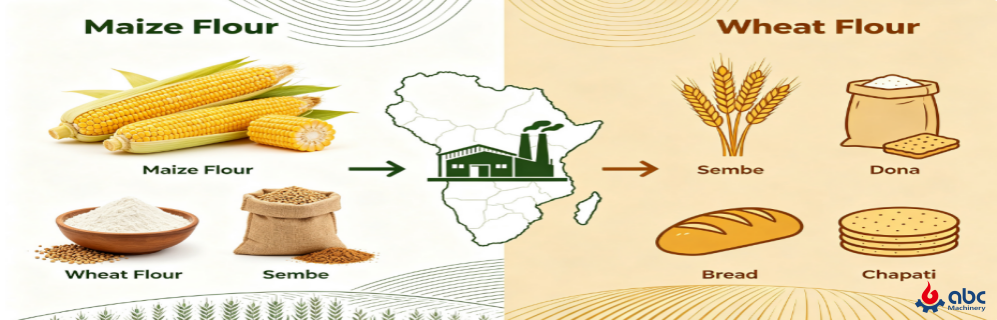
Main Maize and Wheat Flour End Products in Tanzania
The Tanzanian market requires both low‑cost coarse flour and high‑profit refined flour. Modern production lines must support graded flour output to cover urban and rural customers and maximize investment returns. For project investors seeking equipment adapted to high‑impurity grain, unstable voltage and tropical high‑temperature environments, choosing a professional maize milling machine tanzania solution is the most efficient way to build a profitable processing plant. Contact us to get free and professional answers immediately.

Core Criteria for Choosing Flour Processing Equipment in Tanzania
Five key factors decide the long‑term profitability of local milling projects: raw material adaptability, production capacity, power supply compatibility, climate resistance and after‑sales support. Any weakness in these links will reduce equipment stability and economic benefits, making the overall performance of your flour mill unable to meet commercial operation standards.
Raw Material Adaptability: Maize and Wheat Processing
-
Maize materials for milling require a dry and clean state with a moisture content of 13–15% for stable production. Excess moisture causes sieve blockage and increased power consumption. The pre‑processing cleaning system must remove field soil, stones and metal impurities before grains enter the grain mill.
-
The semi‑wet process includes 12–18 hours of grain conditioning and germ removal, producing fine white flour favored by East African consumers with an extraction rate above 85%.
-
The dry process is mainly used for coarse flour for feed and traditional food. A professional corn mill with adjustable roller gaps and multi‑stage sifting can adapt to variable maize hardness in different regions and seasons across Tanzania.
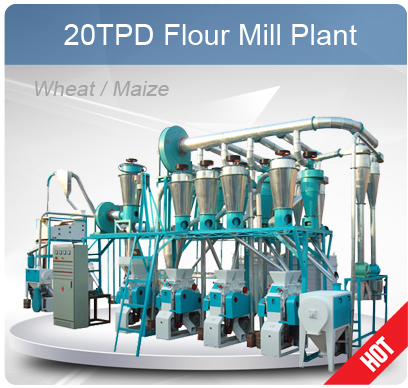
5–50 TPD Modular Capacity Matching
|
Capacity |
Typical Deployment |
Design Priorities |
|---|---|---|
|
5 TPD |
Village or startup factories for local markets |
Low investment, single‑person operation, simplified cleaning system |
|
10–20 TPD |
County‑level factories for shops and institutional clients |
Semi‑wet process, complete cleaning, semi‑automatic control |
|
30–50 TPD |
Urban or export‑oriented large plants |
Continuous production, PLC control, grain warehouse and quality laboratory |
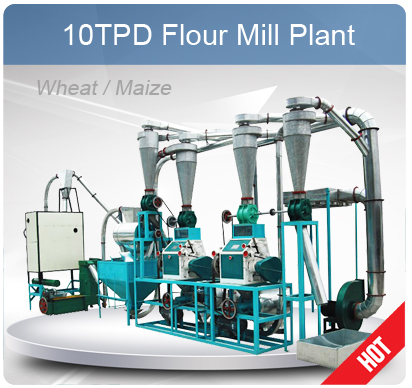
Modular production lines support phased expansion. Investors can start with a 5 TPD small‑scale unit and upgrade to 20 TPD by adding functional modules without replacing the main frame and motor, effectively protecting early investment.
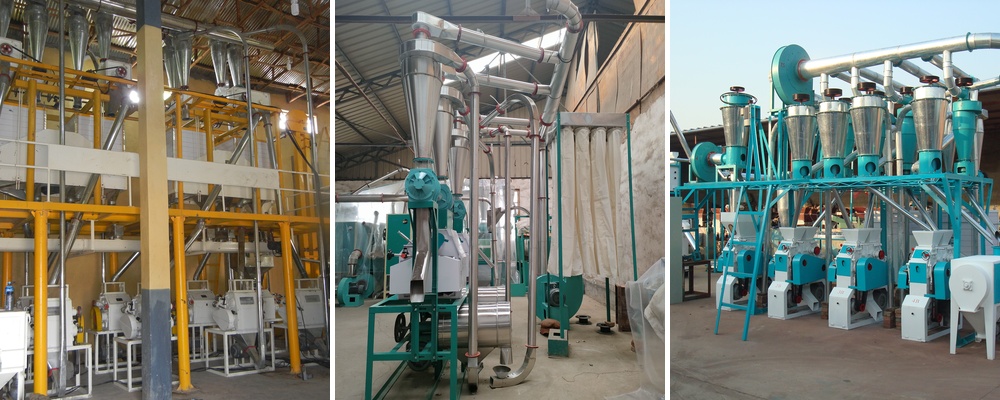
Complete Maize Milling Production Lines for Sale
Power Supply Adaptation for Voltage Fluctuations
-
Unstable power grids are the biggest operational challenge for local processing plants. Peak voltage fluctuations can exceed ±15%, and frequent blackouts seriously affect production stability. Professional motors and electrical control systems must adapt to extreme voltage changes to avoid premature component damage and frequent shutdowns of your wheat mill.
-
IP54 dustproof and moisture proof motors, soft start devices and reserved diesel backup interfaces are essential configurations. All equipment should support 380V/400V/415V three‑phase power supply, and transformers should be equipped for single‑phase power areas. Reasonable electrical configuration is the core guarantee for the stable operation of a high‑quality flour machine in Tanzania.
Humid Tropical Climate and Anti‑corrosion Design
Coastal areas such as Dar es Salaam and Tanga have long‑term high humidity of 70–90% with salt erosion, which easily corrodes ordinary steel equipment. Hot‑dip galvanized frames, plastic‑sprayed panels and food‑grade stainless steel material contacts can greatly extend service life, which is the standard configuration of premium wheat flour machine for East African markets.
After‑sales Service and Spare Parts Support
Wear parts including grinding rollers, screen meshes and belts determine the full‑cycle operating cost of processing plants. High‑quality corn mill machine suppliers will provide complete wear part lists and stable supply guarantees.
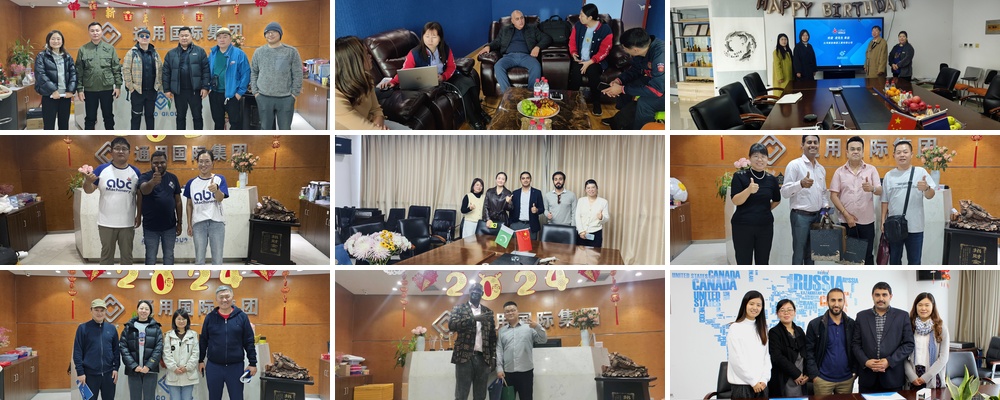
Overseas Buyers Visit ABC Machinery Factory for Custom Milling Project Consultation
How to Choose a Reliable Flour Equipment Supplier in Tanzania
Selecting a milling equipment supplier cannot rely solely on parameters and quotations. It is necessary to comprehensively evaluate local working condition adaptability, customization capability, qualification certification, logistics delivery, overseas installation and after‑sales system. As a professional manufacturer focusing on the East African market for many years, ABC Machinery optimizes equipment structures for local climate, power and raw material conditions, providing stable solutions for wheat processing and maize milling projects.
|
Service Stage |
Service Content |
|---|---|
|
Pre‑sales |
Customized local processing solutions, free capacity calculation, workshop layout design and accurate budget planning for grain mill machine projects of all scales. |
|
Mid‑sales |
Africa‑specific reinforced equipment production, complete English customs declaration documents, shockproof and moisture‑proof ocean packaging and full‑process delivery tracking. |
|
After‑sales |
Overseas on‑site installation and commissioning, English operation training, complete supporting wear parts, 24‑hour cross‑border technical support and equipment upgrade services for formal grain processing enterprises. |
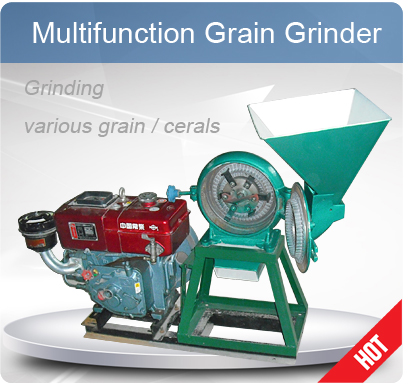
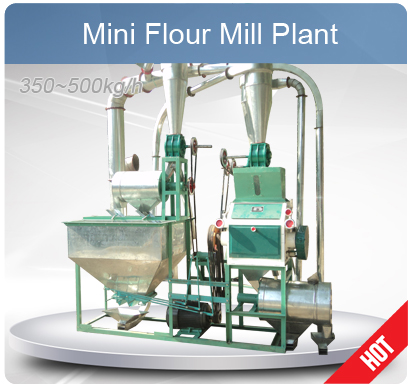
ABC Machinery provides full‑series processing equipment covering efficient flour milling machine units that can professionally mill flour from various grains. Are you planning to build new facilities or upgrade existing milling assets in Tanzania? Contact ABC Machinery for customized line proposals, formal quotations and complimentary workshop layout design to accelerate commissioning and profit generation. Our product portfolio includes high‑performance flour milling machine units suitable for varied output scales.

Projects