 Build Your Future!
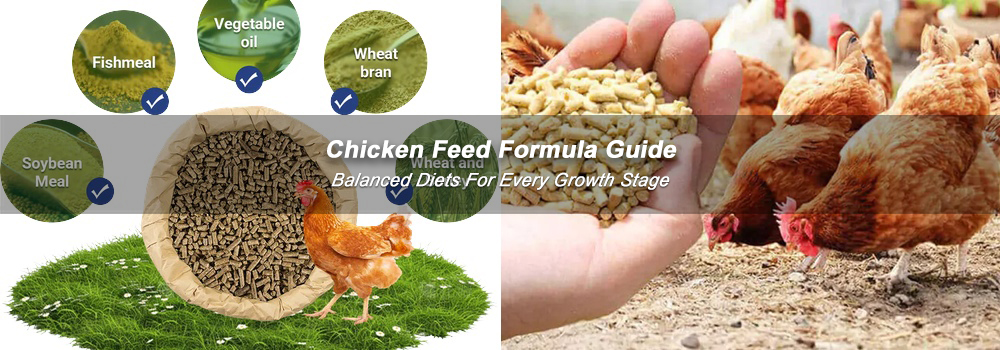
Chicken Feed Formula Nutrition Guide
Chicken Feed Formulation Guide – Typical Feed Formulas
Formula 1 (Balanced Nutrition for General Performance)
chick starter feed formula (0–4 weeks): 50% corn, 32% soybean meal, 5% vegetable oil, 6% wheat bran, 5% premix and minerals, 2% limestone/dicalcium phosphate.
grower feed formula (4–8 weeks): 55% corn, 25% soybean meal, 6% wheat bran, 5% vegetable oil, 6% premix and minerals, 3% calcium sources.
finisher feed formula (8 weeks to market): 60% corn, 20% soybean meal, 7% wheat bran, 5% vegetable oil, 5% premix and minerals, 3% calcium sources.
Formula 2 (Cost-Effective Feed Mix)
chick starter feed formula: 58% corn, 28% soybean meal, 3% canola meal, 3% oil, 5% premix/minerals, 3% calcium sources.
grower feed formula: 62% corn, 23% soybean meal, 5% canola meal, 3% oil, 5% premix/minerals, 2% calcium sources.
finisher feed formula: 65% corn, 20% soybean meal, 5% wheat bran, 3% fats/oil, 5% premix/minerals, 2% calcium sources.
Formula 3 (High-Protein Mix for Faster Growth)
chick starter feed formula: 45% corn, 38% soybean meal, 5% fishmeal, 4% oil, 5% premix/minerals, 3% calcium sources.
grower feed formula: 50% corn, 30% soybean meal, 5% fishmeal, 5% wheat/barley, 4% oil, 4% minerals/premix, 2% calcium.
finisher feed formula: 55% corn, 25% soybean meal, 4% fishmeal, 5% wheat bran, 4% oil, 5% premix/minerals, 2% calcium.
Nutrient Requirement Models And Engineered Chicken Feed Formula Design
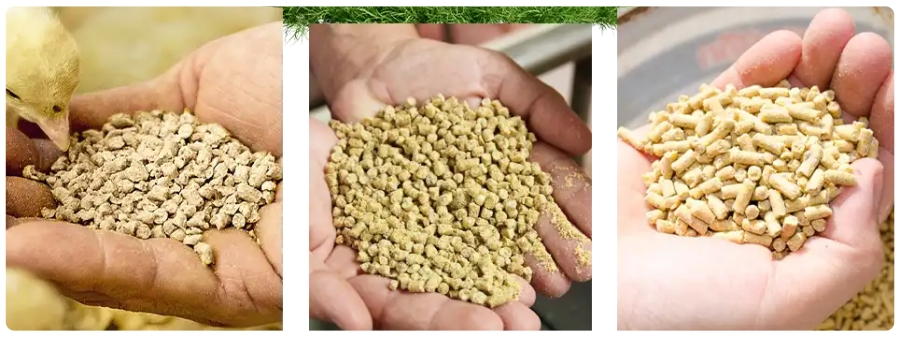
Different Chicken Feed Pellet Size for Different Grow Stage
The foundation of effective poultry feed formulation lies in accurately modeling nutrient requirements across different growth phases. Within the broader landscape of poultry feed formulation, engineers rely on precise data to convert biological needs into practical mill-ready specifications. A well-structured chicken feed formula must integrate metabolizable energy (ME), crude protein (CP), digestible amino acids, and bioavailable minerals into a predictable, stage-based nutrient profile.
Growth Stage Nutrition Modeling Framework
- Starter chicks (0–14 days) typically require 2,900–3,000 kcal/kg ME and 21–23% CP, while grower birds (15–28 days) transition to 3,050–3,150 kcal/kg ME and 19–20% CP.
- Broiler finisher diets reach 3,200–3,250 kcal/kg ME with 17–18% CP, emphasizing energy-driven weight gain with controlled amino acid density.
- Layer hens maintain 2,750–2,800 kcal/kg ME but require elevated calcium at 3.8–4.2%, driven by shell formation needs.
These targets form the basis of the stage-based chicken nutrition model, allowing feed engineers to compute formulations using linear programming and digestibility coefficients.
Amino Acid And Mineral Balancing
Digestible lysine demand decreases steadily from 1.20% in starter diets to 0.90% in finisher diets, while methionine-plus-cystine shifts from 0.90% to 0.70% across the same period. Similarly, available phosphorus reduces from 0.45% in early growth to 0.35% in late phases. Calcium must be controlled with ±0.05% precision to avoid metabolic issues.
Conversion To Engineered Feed Formulas
The transition from nutrient targets to an engineered chicken feed formula design requires incorporating ingredient digestibility, seasonal variability, and pellet durability factors. Each formula is optimized not only for biological performance but also for cost efficiency based on ingredient market prices.
| Growth Stage | ME (kcal/kg) | Crude Protein (%) | Dig. Lysine (%) | Ca (%) | Av. P (%) |
|---|---|---|---|---|---|
| Starter | 2,950 | 22.0 | 1.20 | 1.00 | 0.45 |
| Grower | 3,100 | 19.5 | 1.05 | 0.90 | 0.40 |
| Finisher | 3,230 | 17.5 | 0.90 | 0.85 | 0.35 |
| Layer | 2,780 | 17.0 | 0.75 | 4.00 | 0.35 |
Key Engineering Priorities
- Energy Density Optimization:Aligns ME targets with corn-soy variability for consistent pellet quality.
- Amino Acid Ratio Control:Supports balanced growth and improves feed conversion ratio by 2–4%.
- Mineral Precision:Enhances skeletal strength and productivity through accurate micro-dosing.
- Fiber Adjustment:Maintains gut health using fiber levels between 3–5%.
- Enzyme Integration:Improves nutrient digestibility by 4–6%.
Partner with us to develop a nutrition-driven feed mill strategy that maximizes your flock’s potential and your plant’s efficiency.

Ingredient Selection And Nutrient Density Control For Each Growth Stage
Poultry feed ingredient strategies must align closely with stage-specific demands. Corn supplies 60–65% of energy, while soybean meal provides 40–48% CP with high amino acid availability. Oil inclusion between 1–3% allows fine-tuning of ME levels. These decisions directly influence chicken feed ingredient selection, particularly when balancing nutrient density and cost.
Raw material ME can vary by 80–120 kcal/kg, requiring continuous adjustments within the nutrient density control chicken feed strategy. Ingredient quality testing—protein at ±0.5%, moisture within 11–13%, and mycotoxin thresholds below 20 ppb—is essential for consistent performance.
Procurement teams rely on raw material quality assessment poultry protocols, including rapid mycotoxin screening, fat rancidity checks (<10 meq/kg), and starch digestibility measurements. Unlock performance gains in broiler feed production – Connect with our engineering experts today.
Processing Differences And Their Influence On Chicken Feed Performance
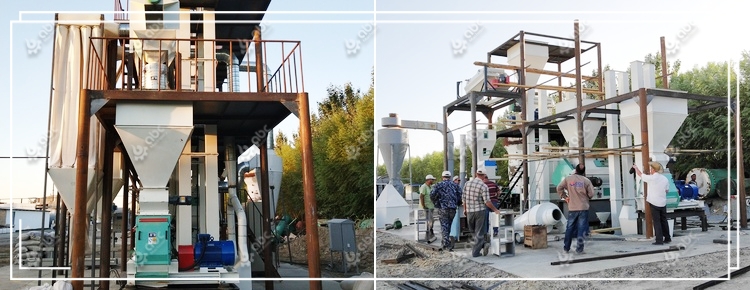
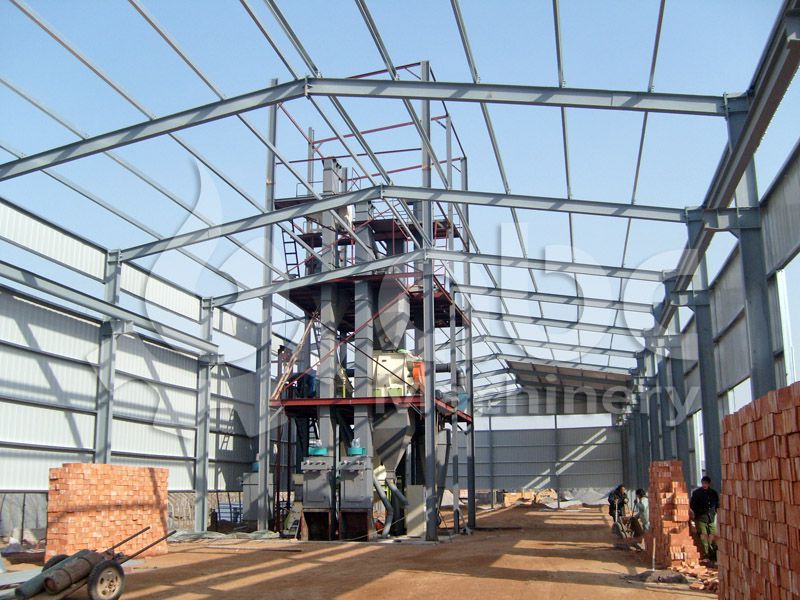
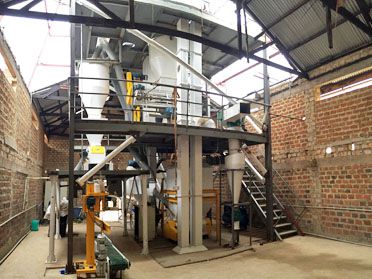
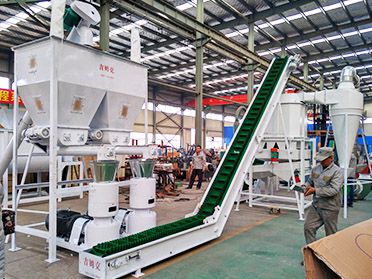
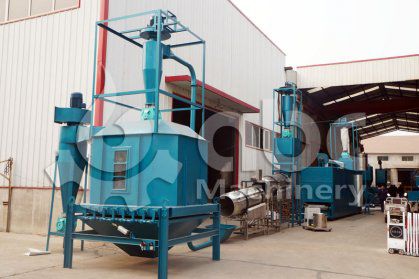
ABC Machinery Provide Turnkey Chicken Feed Production Plant Solutions
Stage-differentiated processing ensures that physical feed characteristics support digestive efficiency. Starter feed requires 450–600 µm particle size for optimal enzyme exposure, while grower and finisher pellets utilize 650–750 µm to enhance gizzard function. These processing adjustments are central to starter, boiler, layer chicken feed processing workflows.
Pelleting systems rely on precise conditioning: steam temperature at 75–85°C, moisture addition of 2–3%, and die pressure calibrated to produce pellet durability (PDI) above 88%. Controlled conditioning parameters in chicken feed pelleting safeguard nutrient integrity, limiting heat-sensitive amino acid losses to less than 3%.
Processing parameters influence pellet hardness, digestibility, and uniformity, all of which directly affect FCR and body weight.
Temperature deviations of ±3°C can reduce pellet PDI by up to 4%, while excessive moisture (>3.5%) increases the risk of pellet breakage during cooling. These factors must be continuously monitored in automated MES (Manufacturing Execution System) platforms.
Get your customized pelleting optimization blueprint – Contact us now.

poultry feed formulation remains central to every engineering step outlined above. A well-designed chicken feed formula integrates biological needs with plant efficiency, supporting sustainable production across starter, grower, finisher, and layer diets.